Q&A WITH WENDELL BURNETTE 2018 WILLIAM F. STERN VISITING CRITIC By Gail Peter Borden, Director of Graduate Programs By Gail Peter Borden, Director of Graduate Programs
GB: Have you had a good time at the University of Houston? I hope your visits have been
inspiring… I know we have enjoyed welcoming you to our community.
WB: It has been an honor and good to come back.
GB: Because you spent time here right?
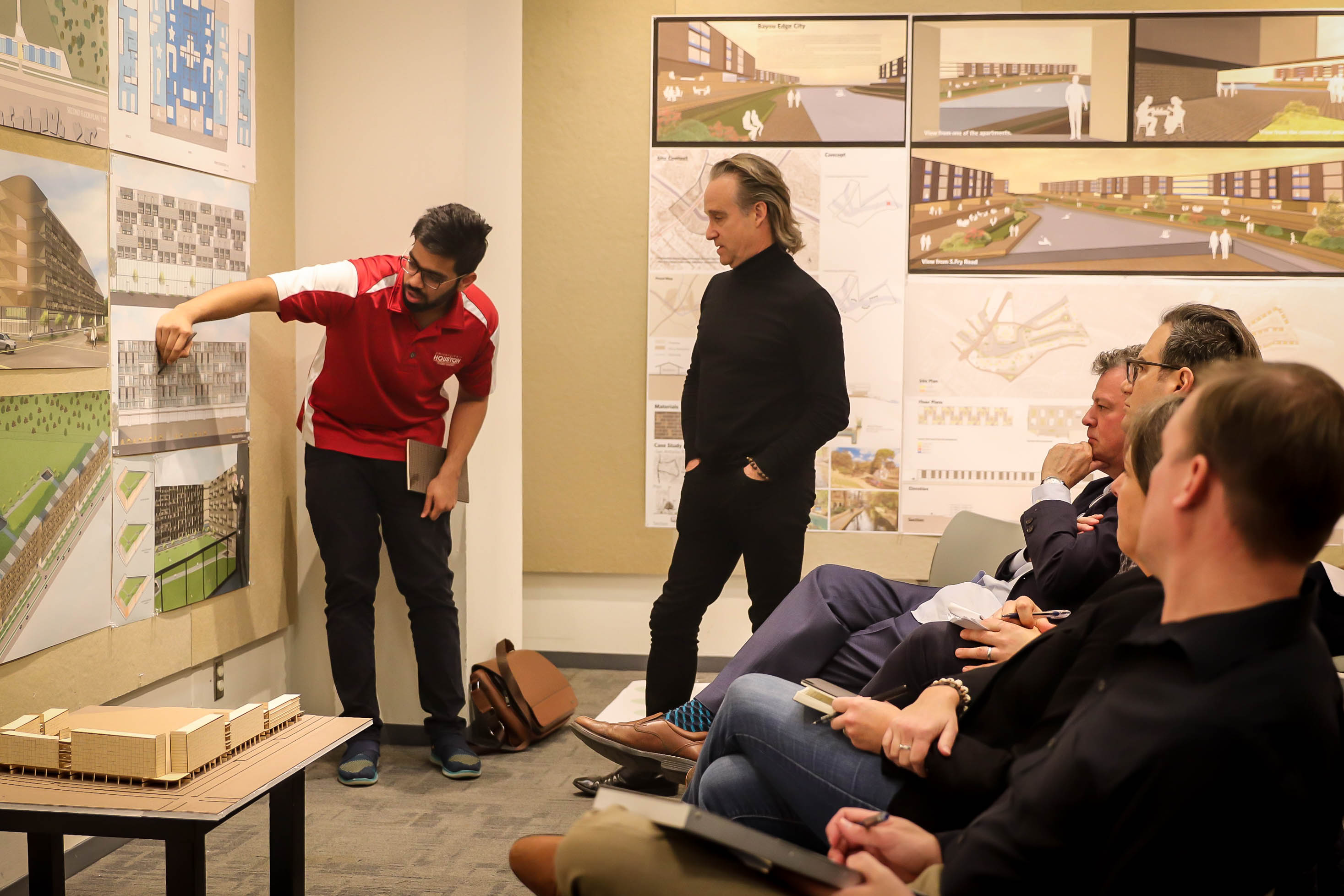
WB: I have family on the Gulf Coast so the idea of coming here and being able to engage this environment: the context, the landscape as well as the urban condition and how those things might co-exist better. So with the Edge City Bayou Studio, we have engaged things that I am interested in as well as addressing and engaging a local condition as something that really needs to be looked at closely. So this opportunity has been great to just have eight students and collaborate with Jesse Hager on this topic.
GB: Houston is a lot like Phoenix on some levels, totally different climatically but urbanistically it seems they are cousins or even closer: siblings.
WB: They are both neck in neck as far as the largest cities in the countries. I think Houston is fourth and Phoenix is fifth and I think you are right it’s an expanding, kind of out of control, metropolis that is colliding with a natural environment. It has been going on here longer. Phoenix is younger, but both demand an inquiry into how we co-exist with the environment. Here I think it is even more pressing with climate change and development and what the city is experiencing in terms of flooding and how does the landscape help the city to co-exist here and maybe working with the landscape as opposed to against the landscape. I think in the case of Phoenix, Houston has imploded more, Phoenix needs to do more of that
GB: Basically folded back on itself
WB: Yes exactly
GB: So I have a series of questions some of which are the underpinnings for my larger ambitions for the graduate program but also for the new Stern Memorial Visiting Professorship. One of the foundational things to both is that there is an assumption in this School that really predates me, but I think is also reinforced by my presence and ambitions, is that thinking through making is a fundamental process for architecture, and that material is intrinsically connected to the object in both form and concept. So in this there is an interest in ideas of craft and materiality, but also an idea that architecture is not only a concerned with the design of buildings, but also how we represent them. So the craft of our ideas, and the craft of the objects that we use to communicate and thus those two acts are inseparable making an argument that you cannot understand Le Corbusier without his paintings, or Mies van der Rohe without the collages, etc. So I am going to unpack it but I want to ask first what is the significance of material, or materiality, in your work? And then what is the significance of representation in your work? As I haven’t actually heard you speak too much about the latter even though you make a lot of beautiful things, things you personally make.
WB: Well, I’ll address the first part of the question. Materiality. I was thinking about
this on the flight over from Mobile, Alabama, and certainly material and engaging
material culture, local material culture, be it an old material or a new material,
or let’s say old technology or old knowledge verses new technology or new knowledge,
for me is always something that we are looking at in my own work and in the work of
the studio and it is something that I am always trying to get students to engage.
It is interesting and difficult for me as I think about this deeply to divorce making
from why something is being made and so I would expand it. The older I get and the
more years under my belt practicing, my architecture and the larger thing that I am
engaged in or focused upon is noble building. Not noble in the aristocratic sense,
but noble in the kind of moral or ethical sense. Noble building is building for place
and purpose. Purpose: why are we building? Who are we building for? This comes into
the choice of materiality. Is it about permanence? Is it temporal? In other words,
a temporal building program might also be noble and being noble does not necessarily
mean permanence. I was in a building yesterday that belonged to an old friend of my
sister, who lived in this original brick tile construction that there was a series
of homes from this place called Clay City, Alabama on the Fish River where they made
brick and brick tile and they came up with this kind of kit home.
I had noticed it on the drive into the little town of Fairhope, Alabama, I noticed
these constructions behind their houses and I was wondering about them, and low and
behold we arrive and we are looking at this house that this family has lived in it
for three generations. They were near the organic school that Marietta Johnson started
in the colony of Fairhope which was a single tax colony that this contemporary of
Alexander Hamilton started where no single person would have ownership of property,
so things belonged to a single colony, so a progressive community, certainly one of
the most progressive in Alabama, but getting back to the material…. It is a very humble
and beautiful material construction. It has worked now for three generations. It is
quite beautiful the textures and colors of this brick. It is all exposed on the outside
and the inside of this home. Then I think about a church that I visited about this
time last year. I was on an AIA jury in Minnesota and I went to a church that was
one of the last works of Eliel Saarenin, when Ereo Saarenin was still working with
him, his son. It is almost eighty years old. It is a brick building and it looks brand
new and it has probably never ever been restored. The detailing, the way it was crafted,
who it was crafted for, and how they cared for it.
It is a testament to noble building and crafting a building that works well for its
intended use, that was able to be added on by Ereo Saarenin, and luckily this congregation
knew to ask him to add on to this building that his father and he had designed earlier.
There is pride in the building because it worked well for them. There is pride in
the building in that it has been easier to maintain. And so these things conspire
in that the building looks as good today as it did eighty years ago in a harsh climate,
so to me let’s say the choice of material, but also how a particular program or need
was addressed, these to me go hand in hand. When I think of our work, materiality
has been important, but it has almost always been tied to how are we addressing the
building program, how are we addressing the budget, how are we addressing the aspirations
of that particular client or project and for us it is usually about a program that
has some permanent role in the community or has to do with something about permanence.
It is all tied together
GB: So materiality is not a destination, it is just an inroad to that idea about noble building.
WB: Yeah. For me it is the act of building. It is not easily changed if you get it wrong.
GB: That’s for sure
WB: If you get the plan wrong or you get the light wrong or the building doesn’t stand the test of time very well which could be all sorts of things, we are probably going to be stuck with that building for quite some time. So if you see a building that is performing as it was intended or it has evolved in a way that allowed it to evolve or it still is looking good and it did not have restored twenty years after it was built … or less..
GB: That is an accomplishment.
WB: This is really what is difficult to teach.
GB: It is difficult to do, little less teach.
WB: It is difficult to do and difficult to teach and yet architects do ourselves a disservice if we don’t rise to the occasion in that regard. I think that if we cheapen what we do or cheapen the services that we provide or if we are not concerned with issues of sustainability, and sustainability is beyond environmental sustainability, it is social sustainability, it is programmatic sustainability, it is detailing a building that doesn’t have to be restored or painted too often. How are we creative or innovative in a way that still meets budgets and schedules, but that also has a longevity and dignity and nobility. The architect must be engaged in a noble enterprise. They must recognize that this does not happen every day and all of the energy and the craft that goes into making a building….. so making involves the materiality and craft but it also involves the politics of making a building, the funding mechanisms of making a building and maintaining a building. Making is more than laying one brick on top of another brick. It is all part of the complexity of building, which is maybe just as complex as it has always been, but doing it in a noble way and recognizing the longevity of building as something important to invest in. The political capital invested. That is a difficult one
GB: Yeah it is all circumstantially driven
WB: It is. It is maybe only expended within four year periods so the kind of mechanisms that allow buildings to happen …… these are all the things that go into making.
GB: So let’s talk about the second part then. The idea of representation. I guess I would unpack that word to include tangents of documentation or simulation. You make beautiful things. You do exquisite drawings and you have meticulous models all over your studio, and you prototype when you get into furniture and other kinds of details … so I am curious about what the role of representation is in your work? As part of your design process? But I am also interested in it when it turns to documentation, because your projects are exquisitely detailed and thought through at a very fine grain. How do you do that? I have seen your CD sets, so they are works of art in their own right, even though they are just technical documentation, but what is your approach to representation?
WB: For us, since the beginning I have always been interested in different modes of representation that are appropriate to each project and also leverage the collaborators in my studio at the time so I think from my experience at Taliesin East and Taliesin West and my interest in the work of Frank Lloyd Wright, meant that I was always interested in perspective and in drawing the image of the project. For me, how I represented the project through drawing in the early stages of the design process was always: are we conveying the intent of the project through drawing. Let’s take the Palo Verde Library and Community Center Maryville as an example. It is a project where its materiality is the big idea of the project. This idea of reverse lantern that sits in the park that allows the park to move through the building. The reverse lantern was also about representing the deep geological context of this place, the valley of the sun, which was about light and the colored air that exists in the Arizona desert sky. So we did a site model to explain the project, really to talk about how we were going to save the 14 acre recreational park, and reduce the parking….
GB: So more organizational.
WB: Yes organizational and how we represented to the people of the community how the park was going to be saved, how they would have enough parking, how the library would associate with the corner park and how the community center would associate with the ballfield and the public pool, but really the renderings which were at the time state of the art computer renderings, were the only way to talk about the material language of the project and really the big idea of the project.
GB: The kind of visual effect.
WB: Yes. How this mill finish stainless steel skin would absorb the colored air and how it would look at winter solstice sunset or summer solstice sunset and how it would look in the evening and how the program would be projected to the street. So for me it is always this very fundamental question I try to ask students: Why are you drawing what you are drawing?
GB: Right. Purpose.
WB: So it’s not a screenshot it is not just a perspective. It is about communicating very explicit intentions about the project and for me as a southerner, someone from the south, dialogue is something very important to our process. Dialogue with the client, dialogue within the studio, dialogue with maybe oneself about the intentions of a project. It is about how do you tell a story and how do you communicate the idea of the project in a convincing and compelling way. And so how we represent a project early on and get consensus with the client and sometimes the community constituents, I have always found that drawing is a highly effective tool for doing that. Often with my clients I am also showing them the process sketches. Really for my method, always the project begins with onion skin sketches. I usually have small stack of sketches. And usually there is a handful of those sketches that I’ll actually share with the client, or pin-up, or put on the table. I find that with clients it is how you share your thought process and for us though it may not immediately happen, but slowly but surely there is a complete story. For me, the drawings are our props for communicating that
GB: The narrative.
WB: The narrative. How the project has taken shape. What has informed the shape that it has taken and then the drawings at the early stage, then come the renderings. Usually it is sharing that process and then they are engaged, they are invested, they are involved in that midpoint of the process and then we come with the renderings
GB: The representational visualizations.
WB: More robust ways of visualizing the project and we usually find then there is a lot of buy-in with that. What is interesting is that what is happening now with technology as we develop our documents say on the Roche Forum in Orrell Valley in Arizona, which is the drawing I am going to donate to the University of Houston’s Public Art Collection, we are actually evolving now the projects in the construction documents through detailing, interior design, furniture, creating the whole environment. Now we are rendering that, continuously updating that model, and now actually doing much later renderings that are almost really as close to building.
GB: Truly photorealistic because all of the details and design decisions are there.
WB: All the details are there. We are actually making adjustments in the interior design, furniture design, certain finishes, and materiality. We are basically sending a material schedule to the renderer and all of these materials and colors and things are being dialed in. We are actually able to adjust, and show the client the final vision.
GB: It is a full feedback loop at this point.
WB: Yes. Really. And it is quite exciting because you really get to taste the final building. For me, being old school, I can see that and I know where we are going, but it is another tool. It is another tool that allows us to refine and test further. I always recognize it is still not the final.
GB: Sure it is not the same thing.
WB: But it is another way of drawing which is why I am choosing that as the drawing to share as it maybe talks about the evolution of drawing. I don’t think one is divorced from another: the sketch, with the erasure, the process at the beginning which is sloppier. And actually for me doing those final drawings I am very particular about what is up to standard and what isn’t.
GB: That is a real edit.
WB: Right. The quality of that we are pushing the boundaries of: Is the light right? Is the material reading properly in that final drawing? And we are as particular from the beginning to the end. The detailing the construction documents, for me, I get a particular satisfaction redlining the final construction documents, and that is not only our architectural drawings, that is the entire set of documents: structural, mechanical, plumbing, electrical… and knowing that we have visualized the final and completed project in the Khanian sense where everything has its place, everything is thought through, everything is coordinated and it has this effortless quality where what we have chosen to express is expressed, where what perhaps we have chosen to suppress is suppressed. How does it have this elemental kind of quality that we are striving for and for us it is about hierarchy and how a suppression allows for the elevation of another quality, say the color of light, so we minimize the number of things the eye is looking at so that you can focus on the quality of light on a material in a space. That which makes the building work or tick is receding. Everyone has a different intent in how they are crafting a space, for me it is about the space itself, as you approach the project from the outside and from within.
GB: Space is the continuity.
WB: A spatial experience.
GB: I am interested about this conversation you phrased: the Wrightian legacy, which is the pedagogical model you come from, that has emphasis on the image of the project verses what might be categorized today as the diagram or the concept. Not that those are necessarily in opposition, the image verses the diagram these are not a dialectical relationship, but I am curious about the diagram describing form or geometry or experience. Do you do a lot of diagramming? You speak very clearly about very focused ideas, do you ever translate them into representation? Even just internally?
WB: It is certainly a timely question. I think any good idea has to be able to be expressed in a clear statement. A sentence. And yet…… lets’ take BIG….
GB: Who have harnessed the diagram in a new justifying way.
WB: This is why we are asking this question. I think that it is a double edged sword in my opinion. I both respect his ability to present every project in a clear diagram or a clear set of diagrams but I often find that it’s dumbing down architecture. It is a schtick. In my opinion it is a bit of a trick. Everyone has their schtick and what I would applaud most is that he has clearly developed a schtick, it is very successful. Some of us have better schticks than others, but what I find a little suspect is when it is dumbed down to the point that the client is sitting there thinking this is so simple.
GB: It is a false empiricism in some ways. It suggests A + B + C = architecture.
WB: And this is what I was going to say that 1+1=2 and if I don’t get this I must be stupid and what you find often is that…… I’ll take the Park City Utah competition which he won and for me I could immediately see through it and then eventually even though he won he did a second scheme and nothing is built now. The competition is a failure and it did not succeed as a project and there are many reasons for that which I know nothing about, but it was a little disturbing that the way the diagram presented the project and I think it was flawed and certainly there are projects that I think are quite successful and the diagram served a very good purpose and I do fundamentally see it as a form of as I was saying earlier that any good project should be capable of being described in the simplest of terms and yet…. if one has to go through that process which competition don’t always allow…. and if the first rule of architecture according to H. H. Richardson is “get the job”
GB: It is not “do no harm” like the Hippocratic Oath for doctors…..
WB: Yes…perhaps it should be ….. So can argue that getting the job is important, winning the competition is important and then how we test a diagram and then continue to test, and I think for a master architect to distill a project down to a diagram takes time to get to that level. For students I think it is important to be able to reverse engineer their thinking and present the salient idea of the project, but to know how you manifest a project where it achieves the power of the diagram or the power of the narrative or the power of that initial idea, there is a huge process there to make that happen and if the idea is distilled enough, what I find the more one can distill the absolute essence of what the project should be then you know better how to test the project through its evolution. Which I find is always a very important thing: how do you keep your eye on the endgame? How do you make sure you are actually going to achieve that initial idea at the end of the project? and how you deliver a project that has the power of the promise of that diagram or that narrative? I think that is the most useful thing. I try to talk to students about writing a narrative about what are the intentions of the project and trying to suggest that they resist describing or designing the project in the narrative. That the narrative should be about what are the goals of the project
GB: Interesting. Textual to divorce form.
WB: That are more open ended and not predetermined. The solution to achieve those goals is not predetermined.
GB: They are high concept.
WB: There are multiple options about how you achieve that goal and how you test different approaches that are always going back to that initial narrative which may not have in that initial narrative a preconception of what the solution is in architectural terms. It is only what the solution needs to achieve in architectural terms, no how, but why. I think this is difficult to teach but is really critical. One of my favorite quotes by an architect is by Louis Sullivan who said: ”It is always fatal to a solution to have a preconception about what it should be, could be, or ought to be.” Knowing what you are going for but not necessarily knowing how you are going to get there until you have gone down several paths and some of those might have been dead ends, but those teach you the path you need to be on.
GB: I like that, it is like navigating, you have markers and guideposts in the distance, so it is not localized decisions alone but the larger way finders. Along that line, do you sketch or draw or represent architectural ideas without a specific project or client or site in mind? Do you bank these narratives? You have an experience of a change of light or a contextual happenstance, do you bank that stuff? I feel like Steven Holl would do his watercolors whether or not he had a client. He would pursue an idea. Now he is so busy I think every watercolor matches with a project. Do you work that way? And I don’t necessarily mean just in the production of things, do you try to work on ideas independently or the projects give you enough to take your full concentration?
WB: The honest answer for me is no. I really don’t. I really am only focused on the work at hand. The latest call.
GB: Really?
WB: That is not to say that I don’t drive by a site…
GB: Yeah… you drive by a site and envision… man do I have an idea for that
WB: Yeah…. This is an interesting distinction. I was thinking about this question in advance as you gave them to me ahead of time. It is interesting because it goes to something I said in the beginning, for me the project usually does not exists without a client without a program and really to be honest my work is very much driven by the prosaic .
GB: Solutions to very specific demands of a project…… budget, client…
WB: Yeah. I was attending a lecture by Thom Mayne and he was talking out loud about other architects that profess that they want to do this or that project. He was very honest in saying: “look, I have never thought about what I am doing or want to do, I am just picking up the phone and doing what is in front of me and taking the next call,” which I found refreshing because I am somewhat the same way. I would say an exception is that I had gone to do this jury in Minnesota and I went to see this Abbey by Marcel Breuer, and even for architects that are well-travelled, they are really stopped in their tracks by this project, so I knew I had to do that. It was really quite powerful, it is a cathedral that he did for this abbey about an hour and a half outside of Minneapolis, a master work of Marcel Breuer, and also the Saarinen church I mentioned before….. I have a good friend of mine that does a lot of churches, and I thought to myself while I was in these two churches that I would love to do a church. I was thinking it quite powerfully out loud in my mind and I got back and I had received an email from this friend and he was recommending me for a church project. I had to call him and thank him and then I had to call the lady that was running the selection committee and I told her this story and actually got the commission to do the first phase feasibility study for a Unitarian Universalist Church in Phoenix and I just received an email that their fundraising has begun and they are ready to go to the next level.
GB: Nice! It is happening. You have to visualize to actualize.
WB: Years ago, Marwan Al-Sayed and Rick Joy and I were all talking about doing hotels. Both Rick and I were giving them as studio problems at universities we were teaching at and we were actively engaging the hotel program as a program of experience, about designing experientially and putting an importance on experiencing place and designing work that is resonant with place, and then we end up working for Aman Resorts which is a kind of anti-hotelier that is about doing work that is not formulaic but is always resonant with culture and place and so sometimes in that way, which is maybe having a particular interest in something, or designing a studio around a particular problems and let’s say investigating that and maybe putting it out there that you are actually putting energy toward engaging a particular issue or something you are passionate about in your own work. The act of actually doing that leads to a project. I think this can happen. This is how the world works sometimes. I was driving by a site this weekend, and I have driven by this site for years. It is now for sale and it is a site that is clearly for some type of real estate development. It is a site with these beautiful live oak trees and what I was imagining very quickly the premise of how do you meet the goals of the proforma
GB: How do you develop it without killing it.
WB: Yes. How do you save each and every tree? and the project weaves in and around these live oaks. I was involved in a competition recently. I was presenting it overseas and it is an international competition and we are competing against some of the leading practices in the world and one of the eight required boards was place making and this is a very special site in a very special desert. Our premise was let’s be clear there is already a place
GB: You don’t need to “make” anything.
WB: Yes, we are trying to preserve place and if we are going to be here, how do we preserve the history and the context in a way that allows people to experience what already exists. I think it is very easy as architects to screw it up, to actually impose upon a place and tip the balance to where it is more about the architecture that it is the place. It is a question of what is more important. For me it would be an anathema. My goal is to not see people posting an image of themselves with the architecture.
GB: It is not your ambition to have an Instagram feed on your website? Ha….
WB: My ambition would be for them to post their experience of the place. It might include elements of the architecture or the architecture allowed them to experience this place
GB: It facilitated it.
WB: Yes. To me there is a fundamental difference. For me it would be how do you do a
project that recognizes the assets of the site and work with them as opposed to against
them. It allows that to be the most equal experience. That it is not imposed on the
land. This idea is nothing new. Wright talked about doing this. I think maybe we can do
it even more sensitively. We should have more knowledge about how to do that better
and maybe do it in a more resonant way which doesn’t predict a certain type of material.
There are many different responses to a site of live oak trees. One is they live,
but then what is the choice of the material? What is the typology? Is it a series
of courtyards? Is it an interweaving pattern? What is the plan? What is the section?
What is the material? And what works with the existing condition as opposed to against
it? It is interesting, Peter Zumthor just came out with a book: A Feeling of History, it is specifically about looking at history: cultural history, natural history…..
I talk about how artists look at a place. I have begun to put artists and historians
in the same position.
How historians look at place, and that might be a natural historian, a cultural historian
and anthropologist, whatever angle … and for me it is difficult to walk on any site…
whether urban or remote and not really engage every aspect of that site possible because
you never know what is going to be important to what one might do there. I would say
that is true maybe for a very aspirational project. Let’s take Zumthor’s Mining Museum
that this book is somewhat about, or a housing development on a site that has never
been developed in the Sonoran desert in my region or this site of live oaks in your
region; how do we approach every project with a certain sensitivity? It doesn’t cost
any more money to approach things sensitively. Whether it is a project with a big
budget or a small building; whether temporal or about real estate development and
economics; or a museum or a cultural institution of more permanence; I think we can
approach our projects in a more sensitive way. This is what we bring to the table
as architects verse mere building. It is how we do noble building versus building
that doesn’t care.
GB: So what is the next step and ambition for you and your practice? Is it just to answer the phone? I am not sure I believe that, because your work is way to beautifully evolutionary. I see a complexity and mastery even from your own house which is rigorous but about a singular mark to jump forward to say the Desert Courtyard House where there are subtle complexities and much more localized responses that I think comes out of a big gesture but has so much richness to it. I see an evolution in in the work and I am curious about what is next.
WB: Well….. I would like to build more.
GB: Civic? Residential? Does it matter?
WB: It does not matter. I would like to build more. I certainly really enjoy doing civic work and we have had the privilege and the honor to do some important civic work in our community. I relish doing that work. I think we are very good at it. I wish I was better at getting the job.
GB: So do I.
WB: I wish we were building more than we do, but on the other hand, we have had extraordinary opportunities. We now have a very good balance of local Phoenix or Arizona based work. We have international work. I would love to have some national work. I would love to leverage the work we have done locally more nationally. What has always been interesting for our practice and perhaps it maybe is more unique than I give it credit or recognize is that I believe my passions have taken the practice to many different places and it has not been conscious it has been more sub-conscious. I have an affinity for the desert. I practice in the desert and in fact we have had in the last ten to fifteen years extraordinary opportunities to work in deserts not just in our own region
GB: Internationally
WB: Around the world and they are actually deserts that I have read about and been interested in and in certain cases we are some of the first practices to be invited to work there. This is an extraordinary opportunity. There are places that I have traveling purely out of a passion to travel there: I have been in the Namibian Desert, I have been in the Sahara of Morocco, I have been in palmeries of North Africa and all of these earlier travels and let’s say earlier passions have in some strange way have led me to be in a position to operate in a certain way when those calls have come. It is interesting, we don’t actively pursue certain projects. We don’t actively pursue competitions except when we recognize an importance. I have done only three or four in my whole career. We don’t pursue them a lot. We only pursue certain RFQs when we feel we have a good shot. In some strange way, my interest and my passions have made us receive certain calls.
GB: They have prepared you for them.
WB: You do trust in getting those calls or attracting those opportunities you are being prepared to take advantage to meet those opportunities.
GB: I am hoping that your time and experience here in Houston has been pleasurable, but more importantly I hope that it is an opportunity for a project here in Houston. We need a Wendell Burnette to join the ranks of great Houston architecture. Thank you so much.