Mark Allan Goldberg | Department of History
Mark Allan Goldberg
Associate Professor
Phone: (713) 743-3091
Email: magoldberg@uh.edu
Office: 545 Agnes Arnold Hall
Mark A. Goldberg received his BA from the University of Texas at Austin and his MA and PhD from the University of Wisconsin-Madison. His research focuses on U.S. Latina/o/x history, the history of borders, immigration, and race and ethnicity. Professor Goldberg served as Director of the UH Jewish Studies Program from 2017 to 2023, and Interim Director of the UH Center for Public History from 2023 to 2024.
Teaching
Professor Goldberg teaches courses in Latina/o/x history, immigration, Jewish Studies, and early America. In 2018, he was awarded a Teaching Excellence Provost Core Award.
Research Interests
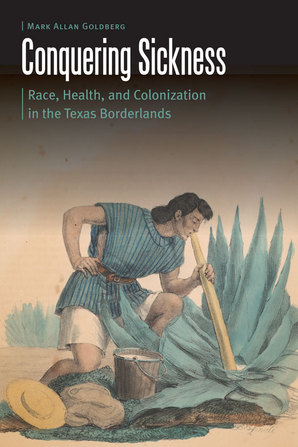
Professor Goldberg is the author of Conquering Sickness: Race, Health, and Colonization in the Texas Borderlands (University of Nebraska Press, 2017). Conquering Sickness examines the role of health and healing in imperial expansion, nation building, and race formation in the 18th- and 19th-century Texas-Mexico border region. Health concerns drove Spanish, Mexican, and Anglo American colonization in Texas, and colonists regularly articulated what behaviors fostered healthy and successful settlement and what behaviors threatened human bodies. In the process, Spaniards, Mexicans, and Anglos defined nonwhites as medical threats to society, empire, and nationhood.
Goldberg is currently working on two projects on the history of Jewish Latina/o/xs in the United States. His book project, tentatively titled “Double Diaspora: Cuban Jewish Migration to Postwar America,” begins in pre-revolution Cuba and tracks Cuban Jews as they transitioned from Cuban nationals to U.S. residents and citizens. In South Florida, U.S. Cuban Jewish newcomers forged a “double diaspora,” rooted in an entangled Cuban Jewish identity born from Jewish life in Cuba, American Jews’ perilous position, and U.S. racial politics. Focusing on members of two overlapping ethnic groups, “Double Diaspora” reveals a more textured view of America and immigration. For the second project, Goldberg is co-editing the anthology, “Histories of Jewish Houston: Exploring Space and Place in the Bayou City,” with Dr. Joshua J. Furman (University of Denver), under contract with the University of Texas Press. The collection of essays approaches Jewish Houston from multiple perspectives, exploring Jewish struggles for inclusion, efforts at institution-building, and relationships with the city’s African American community. Goldberg will be contributing a chapter on Jewish immigration from Latin America in the 1980s.
Professor Goldberg is an affiliate of the Center for Mexican American and Latina/o Studies, the Center for Public History, and the Jewish Studies Program. He has organized an ongoing public-history project related to his research, the Latino Jewish Digital Archive, which includes dozens of oral history interviews as well as written documents from Hebraica Houston, the city’s first Jewish Latina/o/x organization. Goldberg also oversaw teams of UH undergraduates in the development of the Sephardic Latinx Oral History Project, in partnership with Holocaust Museum Houston, and in the production of three podcast episodes on Houston’s immigration history for the CPH series Public Historians at Work.
Professor Goldberg’s work has been supported by funding from the University of Houston, Humanities Texas, the American Jewish Archives, Center for Jewish Ethics, and the Texas State Historical Association. He also has received research grants from the Recovering the U.S. Hispanic Literary Heritage Project, the Southern Jewish Historical Society, and the Texas Jewish Historical Society.
Selected Publications
Book:
Conquering Sickness: Race, Health, and Colonization in the Texas Borderlands (University of Nebraska Press, 2017)
Articles:
- “Forging a Double Diaspora: Cuban Jewish Migration and Settlement in 1960s South Florida,” Journal of American Ethnic History 46, no. 1 (Fall 2026): 5-37.
- “Recovering Hidden Histories: Teaching Latina/o/x Jewish History as Public History” Latin American Jewish Studies 4, no. 2 (Spring 2026): 11-15.
- “The Medical Marketplace in Colonial America,” in The Oxford Handbook of American Medical History, eds. Richard M. Mizelle, Jr., James A. Schafer, and Helen Valier (Oxford: Oxford University Press, 2026), 121-133.
- “Stop calling covid-19 a foreign virus,” Washington Post, March 26, 2020.
- “Curing the Nation with Cacti: Native Healing and State Building before the Texas Revolution,” in Precarious Prescriptions: Contested Histories of Race and Health in North America, ed. Laurie Green, John Mckiernan-González, and Martin Summers (Minneapolis: University of Minnesota Press, 2014).
- “‘It can be cultivated where nothing but cactus will grow’: Local Knowledge and Healing on the Texas Military Frontier,” in Recovering the Hispanic History of Texas, ed. Monica Perales and Raúl Ramos (Houston: Arte Público Press, 2010).
- “Negotiating Nacogdoches: Hasinai Caddo-Spanish Relations, Trade Space, and the Formation of the Texas-Louisiana Border, 1779–1819,” American Indian Culture and Research Journal 33, no. 1 (2009): 65-87.