Faculty Bookshelf
2026

Bridges to Feminism: Marcelle Auclair, Marcelle Ségal and Women's Magazines in Twentieth-Century France (Oxford University Press, 2026)
Sarah Fishman
Journalists Marcelle Auclair and Marcelle Ségal were critical to the success of Elle and Marie-Claire when they began publication in France. True celebrities in the postwar decades, they wielded greater influence on French society than Jean-Paul Sartre, Jacques Lacan, or Michel Foucault. Through their columns and appearances on radio and television, Auclair and Ségal became familiar figures in everyday life. Bridges to Feminism is a dual biography of these trailblazing French journalists who helped reshape how women saw themselves in postwar France. Auclair and Ségal built powerful connections with readers, offering advice, empathy, and a vision of womanhood that defied convention. Their lives vividly distill the twentieth century’s impact on women: war and peace, collaboration and resistance, race and gender, marriage and divorce, parenting and loss. Although they followed the expected paths of marriage and motherhood, life had other plans that forced both of them to reinvent themselves. Uprooted by the 1940 German invasion of France, after the war they rebuilt their lives and became beloved voices for women across France. They encouraged women to trust themselves and embrace their strength. Auclair and Ségal inspired French women to imagine new possibilities for their futures, creating personal, powerful bridges to feminism.
2025

Cuando los trabajadores salieron de compras: Nuevos consumidores, publicidad y cambio cultural durante el primer peronismo, Buenos Aires, Siglo 21, 2025 (3rd edition)
Natalia Milanesio
This book is a study of the emergence of the working-class consumer in Argentina, a social force that shaped a new commercial culture, transformed relationships and collective identities, and redefined the role of the state as a mediator between consumers and business.

Iroquoia: Haudenosaunee Life and Culture, 1630-1783 (Cornell University Press, 2025)
Kelly Hopkins
Iroquoia highlights the innovation of the Haudenosaunee peoples in retaining sovereignty over their homelands through seven generations of social and environmental change following European contact and the settler invasion. Kelly Y. Hopkins argues that Haudenosaunee men and women incorporated articles of European manufacture into their daily lives to fulfill conventional social and cultural needs. They used new trade items and alliances to enhance their lives and to pursue goals specific to their communities. In Iroquoia, Hopkins explores how engagement in the global market economy irreversibly transformed the local environment, severed Indigenous relationships and responsibilities to human and other-than human kin, and challenged longstanding social and economic relationships within Haudenosaunee communities. While settler expansion, violence, and imperial terraforming threatened Indigenous communities, food sovereignty, and water management, The People of the Longhouse produced distinctive new material cultures and new land use practices that incorporated features of the colonial settlement template into longstanding subsistence and settlement patterns. Haudenosaunee peoples employed these survivance strategies to control the scale and scope of European intrusion into their homelands.
Endorsements: This book is a welcome addition to accounts of how Native American individuals and groups creatively adapted and retained their cultures in the Colonial period. Recommended. - Choice
At the heart of Haudenosaunee history, culture, and identity is a homeland that has withstood transformation, invasion, and dispossession. Kelly Y. Hopkins places land and its uses at the center of this well-researched, interdisciplinary history, one that will be of great value to students and scholars alike. - Michael Leroy Oberg, author of Native America.
Iroquoia complicates received scholarly wisdom about changes in Haudenosaunee settlement patterns. I don't know of any comparable work that does so much with cartographic knowledge. A significant contribution to the literature. - Maeve E. Kane, author of Shirts Powdered Red

The Capital of Slavery : Washington, D.C., 1800-1865. International Publishers, 2025
Gerald Horne
Although 1776 and the revolt against British rule leading to the founding of the USA has been thought widely to have planted the seeds of abolitionism, the fact is that the resultant Constitution protected enslaved property, just as the White House, the Supreme Court, and Congress were all dominated by enslavers—before the Civil War. Unsurprisingly, the enslaved themselves engaged in unremitting class struggle—up to and including seeking to overthrow the slaveholders’ republic, e.g. August 1814 when they joined with invaders in torching the White House, sending President Madison and his spouse fleeing, with the newly freed then escaping on British ships to Trinidad and Tobago where their descendants continue to reside. The response from the elite in neighboring Maryland was to seek to deport en masse the “Free Negro” population heavily concentrated in Baltimore to Liberia—as they were blamed for this anti-slavery victory. Enslavers in Virginia too were rattled, especially by the Haitian Revolution (1791-1804) which signaled a general crisis of the slave system that could only be resolved with its collapse. By August 1831 with the revolt of the enslaved led by Nat Turner in the “Cavalier State,” their worst nightmare was realized, leading to further efforts at deportation—this time freeing some of the enslaved and shipping them as well to West Africa. Progressive currents from abroad—British abolitionism in 1833, the revolutionary uprisings in Europe of 1848, etc.—then set the stage for the armed revolt against slavery led by John Brown and his comrades in 1859, which led directly to civil war. Washington—a city with an emerging Black Majority—experienced manumission in 1862—well before the better-known Emancipation Proclamation of 1863, just as the enslavers there were granted compensation—i.e., “reparations”—when their prized property was seized.

Slavery and Capitalism, University of California Press, 2025
David McNally
Slavery and Capitalism gives the first systematic Marxist account of the capitalist character of Atlantic slavery—using colonial travel literature, planter records and diaries, and slave narratives—to support the provocative claim for enslaved labor in the plantation system as capitalist commodity production. Weaving together history, political economy, and radical abolitionism, McNally demonstrates that plantation slaves formed a modern working class. Unlike those scholars who insist that enslaved people were too sensible to set their sights on liberty, he highlights the self-activity of enslaved people fighting for their freedom and reframes their resistance as labor struggles over production and reproduction, with significant implications for US and Atlantic history and for understanding the roots of racial capitalism.
University of California Press

Everyday Life in the Philippines (1657-1699): Selections from the Manuscripts of Juan de Paz (Palgrave Macmillan, 2025)
Norah L. A. Gharala
This book examines the legacy of one of the most influential members of Spanish society in the seventeenth-century Philippines, Dominican scholar Juan de Paz. Using a unique manuscript from the collections of the Archivo de la Universidad de Santo Tomás in Manila, the authors provide a window into the concerns, problems, and entanglements of people of different ethnicities, occupations, and stations in life. Paz’s writings resolving conflicts and weighing in on questions (consultas) have not previously been translated into English. The transcriptions, translations, and editorial introductions collected in this volume therefore make it an invaluable resource for students and scholars interested in the cultural and social history of the Philippines and the Spanish empire.
2024

Armed Struggle? : Panthers and Communists : Black Nationalists and Liberals in Southern California through the Sixties and Seventies. International Publishers, 2024.
Gerald Horne
Southern California has been a leader nationally in fomenting radicalism. The Communist Party had one of its strongest units there, buoyed by influence in Hollywood. Yet, this region also has been a stalwart of the Black Liberation Movement, as suggested by the importance of the Watts Uprising of 1965 in Los Angeles and the concomitant ascendancy of the Black Panther Party, whose leaders—e.g., Eldridge Cleaver and George Jackson—had roots in Pasadena. Angela Davis, accused in the early 1970s of murder, kidnapping, and conspiracy, was not only a bridge between the CP and BPP, but studied in San Diego before teaching at UCLA. Black Nationalism flourished in the Southland: “Kwanzaa,,” a popular holiday, was born there. Given the prominence of Black celebrities in the region, the NAACP chapter in the area was a cash cow for the entire organization and shaped policy accordingly, including their disastrous capitulation to the Red Scare.
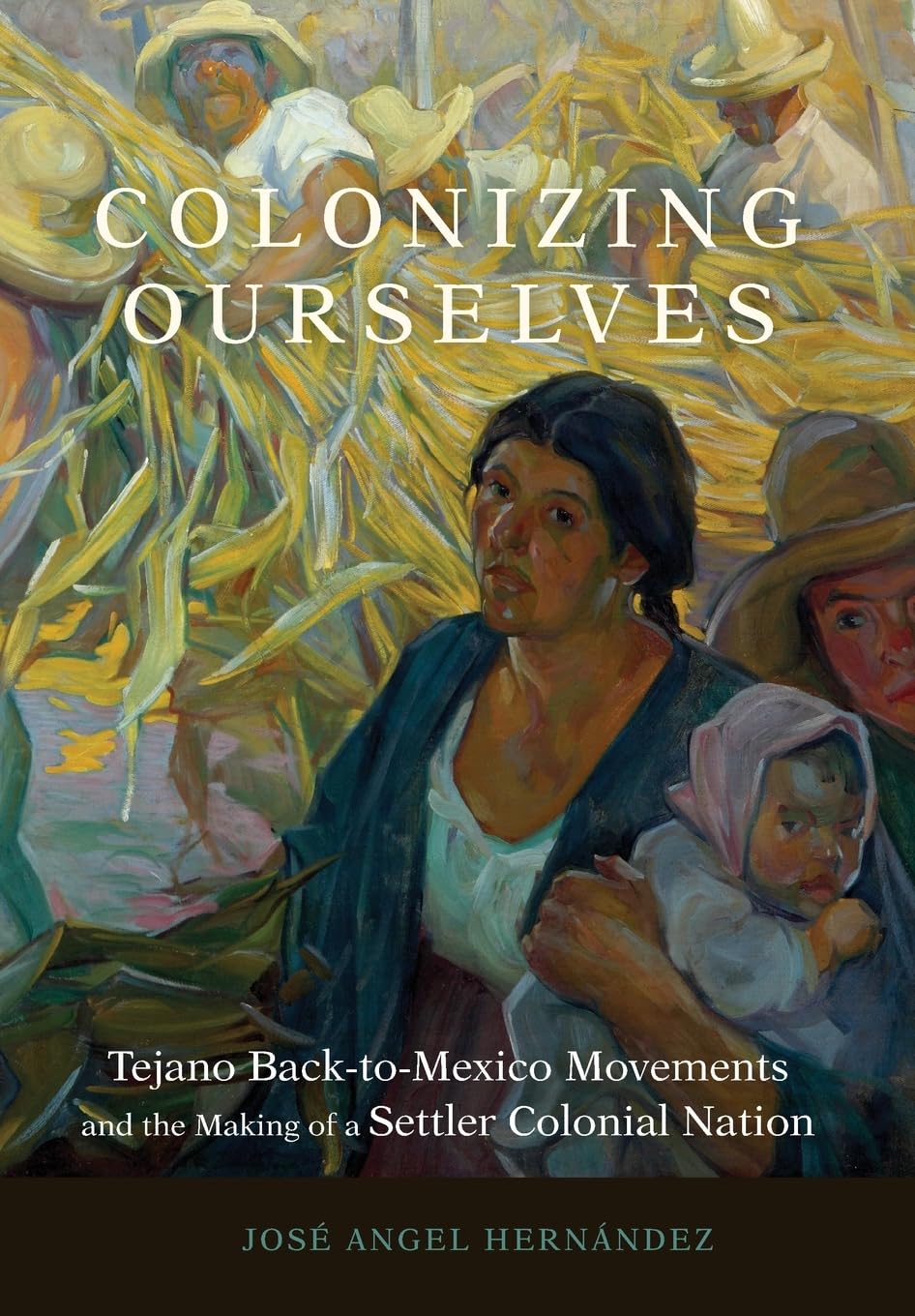
Colonizing Ourselves Tejano Back-to-Mexico Movements and the Making of a Settler Colonial Nation (University of Oklahoma Press, 2024)
José Angel Hernández
In the late nineteenth century, the Mexican government, seeking to fortify its northern borders and curb migration to the United States, set out to relocate “Mexico-Texano” families, or Tejanos, on Mexican land. In Colonizing Ourselves, José Angel Hernández explores these movements back to Mexico, also known as autocolonization, as distinct in the history of settler colonization. Unlike other settler colonial states that relied heavily on overseas settlers, especially from Europe and Asia, Mexico received less than 1 percent of these nineteenth-century immigrants. This reality, coupled with the growing migration of farmers and laborers northward toward the United States, led ultimately to passage of the 1883 Land and Colonization Law. This legislation offered incentives to any Mexican in the United States willing to resettle in the republic: Tejanos, as well as other Mexican expatriates abroad, were to be granted twice the amount of land for settlement that other immigrants received. The campaign worked: ethnic Mexicans from Texas and the Mexican interior, as well as Indigenous peoples from Mexico, established numerous colonies on the northern frontier. Leading one of the most notable back-to-Mexico movements was Luis Siliceo, a Texan who, with a subsidized newspaper, El Colono, and the backing of Porfirio Díaz’s administration, secured a contract to resettle Tejano families across several Mexican states. The story of this partnership, which Hernández traces from the 1890s through the turn of the century, provides insight into debates about settler colonization in Mexico. Viewed from various global, national, and regional perspectives, it helps to make sense of Mexico’s autocolonization policy and its redefinition of Indigenous and settler populations during the nineteenth century.

I Dare Say : A Gerald Horne Reader. OR Books, LLC, 2024
Gerald Horne
I Dare Say: A Gerald Horne Reader is a timely and essential collection of the many works of Professor Gerald Horne—a historian who has made an indelible impact on the study of US and international history. Horne approaches his study of history as a deeply politically engaged scholar, with an insightful and necessarily partisan stance, critiquing the lasting reverberations of white supremacy and all its bedfellows—imperialism, colonialism, fascism and racism—which continue to wreak havoc in the United States and abroad to this day. Drawing on a career that spans more than four decades, this sparkling reader showcases the many highlights of Horne’s writings, delving into discussions of the United States and its place on the global stage, the curation of mythology surrounding titans of 20th Century African American history like Malcolm X, and Horne’s thoughts on pressing international crises of the 21st Century including the war in Afghanistan during the early 2000s, and the war in Ukraine which erupted in February 2022. As we continue to observe the chaos of our current times, I Dare Say: A Gerald Horne Reader foregrounds a firmly rooted, consistent analysis of what has come to pass—and provides illuminating insight that better informs where we may be headed, and outlines what needs to be done to stem the tide of growing fascism across the Western world.
2023

Disparate Remedies: Making Medicines in Modern India (MQUP, 2023)
Nandini Bhattacharya
At present India is a leading producer, distributor, and consumer of generic medicines globally. Disparate Remedies traces the genealogy of this development and examines the public cultures of medicine in the country between 1870 and 1960. The book begins by discussing the expansion of medical consumerism in late nineteenth-century India when British-owned firms extended their sales into remote towns. As a result, laboratory-produced drugs competed with traditional remedies through side-by-side production of Western and Indian drugs by pharmaceutical companies. The emergent middle classes, the creation of a public sphere, and nationalist politics transformed the medical culture of modern India and generated conflict between Western and Indigenous medical systems and their practitioners. Nandini Bhattacharya demonstrates that these disparate therapies were sustained through the tropes of purity or adulteration, potency or lack of it, and epistemic heritage, even when their material configuration often differed little. Uniquely engaging with the cultures of both consumption and production in the country, Disparate Remedies follows the evolution of medicine in colonial India as it confronted Indian modernity and changing public attitudes surrounding health and drugs.

The Deepest South the United States, Brazil, and the African Slave Trade. NYU Press, 2023
Gerald Horne
During its heyday in the nineteenth century, the African slave trade was fueled by the close relationship of the United States and Brazil. The Deepest South tells the disturbing story of how U.S. nationals - before and after Emancipation -- continued to actively participate in this odious commerce by creating diplomatic, social, and political ties with Brazil, which today has the largest population of African origin outside of Africa itself. Proslavery Americans began to accelerate their presence in Brazil in the 1830s, creating alliances there—sometimes friendly, often contentious—with Portuguese, Spanish, British, and other foreign slave traders to buy, sell, and transport African slaves, particularly from the eastern shores of that beleaguered continent. Spokesmen of the Slave South drew up ambitious plans to seize the Amazon and develop this region by deporting the enslaved African-Americans there to toil. When the South seceded from the Union, it received significant support from Brazil, which correctly assumed that a Confederate defeat would be a mortal blow to slavery south of the border. After the Civil War, many Confederates, with slaves in tow, sought refuge as well as the survival of their peculiar institution in Brazil.

Race Woman the Lives of Shirley Graham Du Bois. NYU Press, 2023
Gerald Horne
One of the most intriguing activists and artists of the twentieth century, Shirley Graham Du Bois also remains one of the least studied and understood. In Race Woman, Gerald Horne draws a revealing portrait of this controversial figure who championed the civil rights movement in America, the liberation struggles in Africa and the socialist struggles in Maoist China. Through careful analysis and use of personal correspondence, interviews, and previously unexamined documents, Horne explores her work as a Harlem Renaissance playwright, biographer, composer, teacher, novelist, Left political activist, advisor and inspiration, who was a powerful historical actor.

Revolting Capital : Racism and Radicalism in Washington, D.C., 1900-2000. International Publishers, 2023.
Gerald Horne
There is a fundamental contradiction in U.S. Imperialism: the capital of this empire for decades has had a majority Black population, which—in turn—has created favorable conditions not only for the erosion of the pestilence that is racism but the flourishing of the antidote that is radicalism. In this sweeping history, distinguished author Gerald Horne traces this phenomenon over a century, in a book which should be understood and studied by all anti-imperialist and progressive forces. This relatively small metropolis also has influenced profoundly its neighbors in Maryland and Virginia, especially in the potent area of labor organizing. In turn, D.C. has also been influenced by the shifting international political arena, notably during the Cold War contest with the Soviet Union and as nations around the globe fought for and won independence against colonialism.

Acknowledging Radical Histories: Conversations with Gerald Horne. International Publishers, 2023.
Gerald Horne, and Time
In this collection of conversations spanning several years, Dr. Horne confronts the history of settler colonialism and the fight against fascism while providing dazzling insights on Jazz, Claude Barnett, Paul Robeson, W.E.B. Du Bois, and Shirley Graham Du Bois. He delivers deeper insights into the histories of Kenya, Zimbabwe, and South Africa. Chris Steele’s curiosity as an interviewer creates dialogues where Dr. Horne often braids his journeys into the archives with his scholarship often opening up into his own personal narrative. Part history, part radical memoir, Acknowledging Radical Histories displays the power of conversation, solidarity, and coming together for a better future.
2022

Urban Government and the early Stuart State: Provincial Towns, Corporate Liberties, and Royal Authority in England 1603-1640 (The Boydell Press, 2022)
Catherine F. Patterson
Investigating relations between center and localities in seventeenth century England, this book looks at early Stuart government through the lens of provincial towns. Focusing particularly on incorporated boroughs, it emphasizes the distinctive circumstances that shaped governance in provincial towns and the ways towns contributed to the state. Royal charters of incorporation legally defined patterns of self-government and local liberties in corporate boroughs, but they also created a powerful bond to the crown. The book argues that a dynamic tension between local autonomy and connection to the center drove relations between towns and the crown in this period, as borough governments actively sought strong ties with central authority while also attempting to preserve their chartered liberties. It also argues that the 1620s and 1630s ushered in new patterns in the crown’s relations with incorporated boroughs, as Charles I’s regime hardened policies towards urban localities. Based on extensive original research in both central government records and the archives of a wide range of provincial towns, the book covers critical aspects of interaction between towns and the crown, including incorporation and charters, governance and political order, social regulation, trade, financial and military exactions, and religion.

The Counter-Revolution of 1836 : Texas Slavery & Jim Crow and the Roots of American Fascism. International Publishers, 2022.
Gerald Horne
When Mexico moved to abolish slavery, Texas seceded in 1836 – in a replay of 1776 – in order to perpetuate enslavement of Africans. Until 1845 Texas was an independent nation and moved to challenge the U.S. for leadership in the odious commerce of the African Slave Trade: Texas also competed vigorously with the U.S. in the dirty business of denuding Mexico by snatching California in the race to the Pacific and domination of the vaunted China market. But Texas could not withstand pressure from abolitionist Mexico and revolutionary Haiti and joined the U.S. as a state – under questionable legal procedures – in 1845. Thereafter Texas’ enslaved population increased exponentially along with land grabs targeting Comanches, Caddo, and Kiowa – and other Indigenous nations – leading to staggeringly violent bloodshed.

Class Struggle in Hollywood, 1930-1950
Gerald Horne
As World War II wound down in 1945 and the cold war heated up, the skilled trades that made up the Conference of Studio Unions (CSU) began a tumultuous strike at the major Hollywood studios. This turmoil escalated further when the studios retaliated by locking out CSU in 1946. This labor unrest unleashed a fury of Red-baiting that allowed studio moguls to crush the union and seize control of the production process, with far-reaching consequences. This engrossing book probes the motives and actions of all the players to reveal the full story of the CSU strike and the resulting lockout of 1946. Gerald Horne draws extensively on primary materials and oral histories to document how limited a "threat" the Communist party actually posed in Hollywood, even as studio moguls successfully used the Red scare to undermine union clout, prevent film stars from supporting labor, and prove the moguls' own patriotism. Horne also discloses that, unnoticed amid the turmoil, organized crime entrenched itself in management and labor, gaining considerable control over both the "product" and the profits of Hollywood. This research demonstrates that the CSU strike and lockout were a pivotal moment in Hollywood history, with consequences for everything from production values, to the kinds of stories told in films, to permanent shifts in the centers of power.

Toxic Debt: An Environmental Justice History of Detroit (University of North Carolina Press, 2022)
Josiah Rector
From the mid-nineteenth until the mid-twentieth century, environmentally unregulated industrial capitalism produced outsized public health risks for poor and working-class Detroiters, made all the worse for African Americans by housing and job discrimination. Then as the auto industry abandoned Detroit, the banking and real estate industries turned those risks into disasters with predatory loans to African American homebuyers, and to an increasingly indebted city government. Following years of cuts in welfare assistance to poor families and a devastating subprime mortgage meltdown, the state of Michigan used municipal debt to justify suspending democracy in majority-Black cities. In Detroit and Flint, austerity policies imposed under emergency financial management deprived hundreds of thousands of people of running water, with lethal consequences that most recently exacerbated the spread of COVID-19. Toxic Debt is not only a book about racism, capitalism, and the making of these environmental disasters. It is also a history of Detroit’s environmental justice movement, which emerged from over a century of battles over pollution and public health in the city and involved radical auto workers, ecofeminists, and working-class women fighting for clean water. Linking the histories of urban political economy, the environment, and social movements, Toxic Debt lucidly narrates the story of debt, environmental disaster, and resistance in Detroit.
University of North Carolina Press
2021

El destape: La cultura sexual en la Argentina después de la dictadura, Siglo 21, 2021
Natalia Milanesio
This book reconstructs, from a strikingly original perspective, the intense years of the democratic transition. It reveals that there were many forms of destape: a profound transformation that manifested itself not only in the sexualization of the mass media, but also in the ways Argentines understood, discussed, and lived their sexuality. To demonstrate this, the book examines the rise of sexology and sex therapy, readers’ letters and magazine advice columns on sexual matters, the campaign to introduce sex education in schools, the expansion of family planning services and institutions devoted to sexual health, and the centrality of sexual rights on the agendas of feminist and gay and lesbian activists.

Antioch in Syria: A History from Coins (300 BCE–450 CE) (Cambridge University Press, 2021)
Kristina Neumann
Antioch in Syria critically reassesses this ancient city from its Seleucid foundation into Late Antiquity. Although Antioch's prominence is famous, Kristina M. Neumann newly exposes the gradations of imperial power and local agency mediated within its walls through a comprehensive study of the coins minted there and excavated throughout the Mediterranean and Middle East. Patterns revealed through digital mapping and Exploratory Data Analysis serve as a significant index of spatial politics and the policies of the different authorities making use of the city. Evaluating the coins against other historical material reveals that Antioch's status was not fixed, nor the people passive pawns for external powers. Instead, as imperial governments capitalised upon Antioch's location and amenities, the citizens developed in their own distinct identities and agency. Antioch of the Antiochians must therefore be elevated from traditional narratives and static characterisations, being studied and celebrated for the dynamic polis it was.

The Bittersweet Science. International Publishers Company, Incorporated, 2021
Gerald Horne
Based upon exhaustive research in court records, memoirs, the files of the New York State Athletic Commissions, and related bodies from Nevada to New Jersey – not to mention the gangster venues from garish Las Vegas to venal South Philadelphia – this pioneering work tells the untold story of the grimy intersection of racism and racketeering in boxing. Revealing previously unrecorded stories of punchers from Jack Johnson to Joe Louis to Sugar Ray Robinson to Muhammad Ali, Horne also details a fascinating story of the waxing and waning of anti-Semitism. Toxic masculinity and other offshoots (including homophobia) are a major theme of this book and the author does not neglect women boxers – and wrestlers too – whose skills were honed in day-to-day battles with the pestilence that is male supremacy.
International Publishers Company, Incorporated

Communist Front? : The Civil Rights Congress, 1946 to 1956. International Publishers Company, Incorporated, 2021
Gerald Horne
Communist Front? The Civil Rights Congress, 1946-1956 provides an essential analysis of one of the most important but understudied civil rights organizations of the twentieth century, as well as its leader William L. Patterson. This pivotal formation tirelessly advocated for the rights of African Americans, Communists, and other oppressed and marginalized groups; brought national attention to some of the most egregious frame-ups and miscarriages of justice, from Rosa Lee Ingram to Willie McGee; and helped to internationalize the struggle for Black liberation with the We Charge Genocide petition. It is no wonder, then, that as the Cold War heated up and anti-communist repression reached a fever pitch, the CRC came under constant government surveillance and attack that ultimately led to its untimely demise in 1956.
International Publishers Company, Incorporated

Black Liberation/Red Scare International Publishers Company, Incorporated, 2021
Gerald Horne
Black Liberation/Red Scare is a study of the African American Communist leader, Benjamin Davis, Jr. Though it examines the numerous grassroots campaigns that he was involved in, it is first and foremost a study of the man and secondarily a study of the Communist Party from the 1930s to the 1960s. By examining the public life of an important party leader, Gerald Horne uniquely approaches the story of how and why the party rose and fell. Davis was trained for the Black elite at Morehouse, Amherst, and Harvard Law School. After graduating from Harvard, he joined the Communist Party, where he remained as one of its most visible leaders for thirty years. In 1943, after being endorsed by his predecessor, Adam Clayton Powell, Jr., he was elected to the New York City Council from Harlem and subsequently reelected by a larger margin in 1945. Davis received support from such community figures as NAACP leader Roy Wilkins, boxer Joe Louis, and musician Duke Ellington. With the onset of the Red Scare and the Cold War, Davis – like the Communist party itself – was marginalized. The Cold War made it difficult for the U.S. to compete with Moscow for the hearts and minds of African Americans while they were subjected to third-class citizenship at home. Yet in return for civil rights concessions, African American organizations such as the NAACP were forced to distance themselves from figures such as Ben Davis. In 1949 he was ousted unceremoniously (and perhaps illegally) from the City Council. He was put on trial, jailed in 1951, and not released until 1956, when the civil rights movement was gathering momentum. His friendship with the King family, based upon family ties in Atlanta, was the ostensible cause for the FBI surveillance of Dr. Martin Luther King, Jr. COINTELPRO, the counterintelligence program of the FBI, which was aimed initially at the CPUSA, made sure to keep a close eye on Davis as well. But when the civil rights movement reached full strength in the 1960s, Davis’s controversial appearances at college campuses helped to set the stage for a new era of activism at universities. According to Horne, the time has now come when he, along with his good friend Paul Robeson and W. E. B. Du Bois, should be regarded as a premier leader of African Americans and the U.S. left during the twentieth century.
International Publishers Company, Incorporated
2020
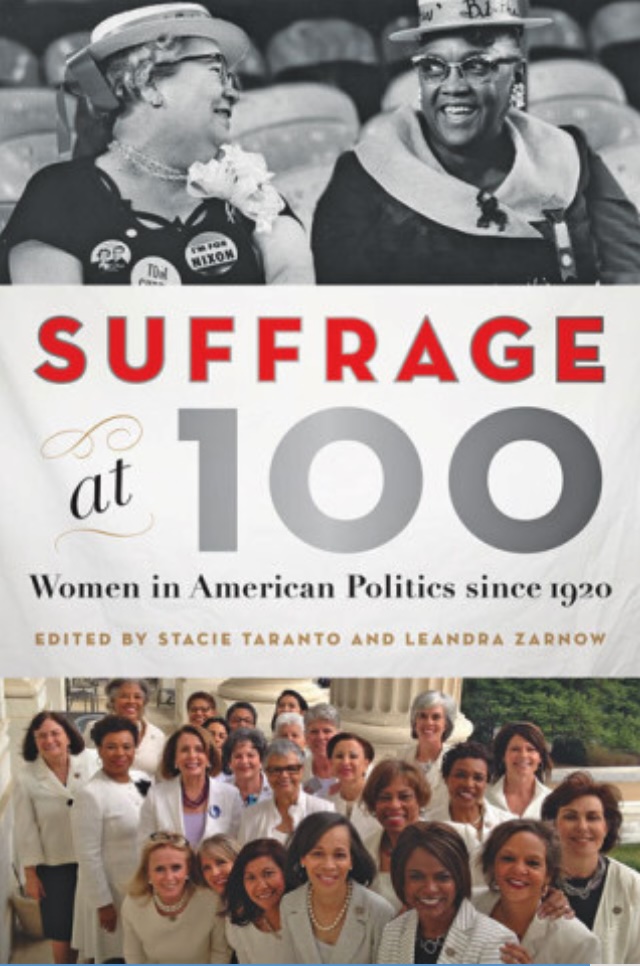
Suffrage at 100: Women in American Politics since 1920, ed. by Stacie Taranto and Leandra Zarnow (Baltimore, MD: Johns Hopkins University Press, 2020).
Leandra Zarnow
In the 2018 midterm elections, 102 women were elected to the House and 14 to the Senate—a record for both bodies. And yet nearly a century after the ratification of the Nineteenth Amendment, the notion of congressional gender parity by 2020—a stated goal of the National Women's Political Caucus at the time of its founding in 1971—remains a distant ideal. In Suffrage at 100, Stacie Taranto and Leandra Zarnow bring together twenty-two scholars to take stock of women's engagement in electoral politics over the past one hundred years. This is the first wide-ranging collection to historically examine women's full political engagement in and beyond electoral office since they gained a constitutional right to vote. The book explores why women's access to, and influence on, political power remains frustratingly uneven, particularly for women of color and queer women. Examining how women have acted collectively and individually, both within and outside of electoral and governmental channels, the book moves from the front lines of community organizing to the highest glass ceiling.
Johns Hopkins University Press

The Things of Life: Materiality in Late Soviet Russia (Cornell University Press, 2020).
Alexey Golubev
The Things of Life is a social and cultural history of material objects and spaces during the late socialist era. It traces the biographies of Soviet things, examining how the material world of the late Soviet period influenced Soviet people's gender roles, habitual choices, social trajectories, and imaginary aspirations. Instead of seeing political structures and discursive frameworks as the only mechanisms for shaping Soviet citizens, Alexey Golubev explores how Soviet people used objects and spaces to substantiate their individual and collective selves. In doing so, Golubev rediscovers what helped Soviet citizens make sense of their selves and the world around them, ranging from space rockets and model aircraft to heritage buildings, and from home gyms to the hallways and basements of post-Stalinist housing. Through these various materialist fascinations, The Things of Life considers the ways in which many Soviet people subverted the efforts of the Communist regime to transform them into a rationally organized, disciplined, and easily controllable community.

Inscriptions of Nature: Geology and the Naturalization of Antiquity (Johns Hopkins University Press, 2020)
Pratik Chakrabarti
In the nineteenth century, teams of men began digging the earth like never before. In Inscriptions of Nature, Pratik Chakrabarti argues that, in both the real and the metaphorical digging of the earth, the deep history of nature, landscape, and people became indelibly inscribed in the study and imagination of antiquity. The first book to situate deep history as an expression of political, economic, and cultural power, this volume shows that it is complicit in the European and colonial appropriation of global nature, commodities, temporalities, and myths. The book also provides a new interpretation of the relationship between nature and history. Arguing that the deep history of the earth became pervasive within historical imaginations of monuments, communities, and territories in the nineteenth century, Chakrabarti studies these processes in the Indian subcontinent, from the banks of the Yamuna and Ganga rivers to the Himalayas to the deep ravines and forests of central India. He also examines associated themes of Hindu antiquarianism, sacred geographies, and tribal aboriginality. Driven by the geological imagination of India as well as its landscape, people, past, and destiny, Inscriptions of Nature reveals how human evolution, myths, aboriginality, and colonial state formation fundamentally defined Indian antiquity.
Johns Hopkins University Press

The Dawning of the Apocalypse : The Roots of Slavery, White Supremacy, Settler Colonialism, and Capitalism in the Long Sixteenth Century. Monthly Review Press, 2020
Gerald Horne
August 2019 saw numerous commemorations of the year 1619, when what was said to be the first arrival of enslaved Africans occurred in North America. Yet in the 1520s, the Spanish, from their imperial perch in Santo Domingo, had already brought enslaved Africans to what was to become South Carolina. The enslaved people here quickly defected to local Indigenous populations, and compelled their captors to flee. Deploying such illuminating research, The Dawning of the Apocalypse is a riveting revision of the “creation myth” of settler colonialism and how the United States was formed. Here, Gerald Horne argues forcefully that, in order to understand the arrival of colonists from the British Isles in the early seventeenth century, one must first understand the “long sixteenth century”– from 1492 until the arrival of settlers in Virginia in 1607. During this prolonged century, Horne contends, “whiteness” morphed into “white supremacy,” and allowed England to co-opt not only religious minorities but also various nationalities throughout Europe, thus forging a muscular bloc that was needed to confront rambunctious Indigenes and Africans. In retelling the bloodthirsty story of the invasion of the Americas, Horne recounts how the fierce resistance by Africans and their Indigenous allies weakened Spain and enabled London to dispatch settlers to Virginia in 1607. These settlers laid the groundwork for the British Empire and its revolting spawn that became the United States of America.
2019

Destape: Sex, Democracy, and Freedom in Postdictatorial Argentina, University of New Mexico Press, 2019
Natalia Milanesio
Under dictatorship in Argentina, sex and sexuality were regulated to the point where sex education, explicit images, and even suggestive material were prohibited. With the return to democracy in 1983, Argentines experienced new freedoms, including sexual freedoms. The explosion of the availability and ubiquity of sexual material became known as the destape, and it uncovered sexuality in provocative ways. This was a mass-media phenomenon, but it went beyond this. It was, in effect, a deeper process of change in sexual ideologies and practices. By exploring the boom of sex therapy and sexology; the fight for the implementation of sex education in schools; the expansion of family planning services and of organizations dedicated to sexual health care; and the centrality of discussions on sexuality in feminist and gay organizations, Milanesio shows that the destape was a profound transformation of the way Argentines talked, understood, and experienced sexuality, a change in manners, morals, and personal freedoms.
University of New Mexico Press

Battling Bella: The Protest Politics of Bella Abzug (Cambridge, MA: Harvard University Press, 2019).
Leandra Ruth Zarnow
The 1970 congressional election season saw Bella Abzug, in her trademark broad-brimmed hats, campaigning on the slogan “This Woman’s Place Is in the House—the House of Representatives.” As a trailblazing New York congresswoman, she advanced the feminist agenda in ways big and small, from gaining full access for congresswomen to the House swimming pool to cofounding the National Women’s Political Caucus to putting the title “Ms.” into the political lexicon. Beyond women’s rights, “Sister Bella” promoted gay rights, privacy rights, and human rights, and pushed legislation relating to urban, environmental, and foreign affairs. Her stint in Congress lasted just six years—it ended when she decided to seek the Democrats’ 1976 New York Senate nomination, a race she lost to Daniel Patrick Moynihan by less than 1 percent. Their primary contest, while gendered, was also an ideological struggle for the heart of the Democratic Party. As 1960s radicalism moved protest into electoral politics, Abzug drew fire from establishment politicians across the political spectrum—but also inspired a generation of women.

The Battle of Negro Fort: The Rise and Fall of a Fugitive Slave Community
Matthew J. Clavin
In the aftermath of the War of 1812, Major General Andrew Jackson ordered a joint United States army-navy expedition into Spanish Florida to destroy a free and independent community of fugitive slaves. The result was the Battle of Negro Fort, a brutal conflict among hundreds of American troops, Indian warriors, and black rebels that culminated in the death or re-enslavement of nearly all of the fort’s inhabitants. By eliminating this refuge for fugitive slaves, the United States government closed an escape valve that African Americans had utilized for generations. At the same time, it intensified the subjugation of southern Native Americans. Still, the battle was significant for another reason as well. During its existence, Negro Fort was a powerful symbol of black freedom that subverted the racist foundations of an expanding American slave society. Its destruction reinforced the nation’s growing commitment to slavery, while illuminating the extent to which ambivalence over the institution had disappeared since the nation’s founding. Indeed, four decades after declaring that all men were created equal, the United States destroyed a fugitive slave community in a foreign territory for the first and only time in its history, which accelerated its transformation into a white republic.

W.E.B. Du Bois. ABC-CLIO, LLC, 2019
Gerald Horne and Charisse Burden-Stelly
This revealing biography captures the full life of W.E.B. Du Bois—historian, sociologist, author, editor, and a leader in the fight to bring African Americans more fully into the American landscape as well as a forceful proponent of their leaving America altogether and returning to Africa. Drawing on extensive research and including new primary documents, sidebars, and analysis, Gerald Horne and Charisse Burden-Stelly offer a portrait of this remarkable man, paying special attention to the often-overlooked radical decades at the end of Du Bois's life. The book also highlights Du Bois's relationships with and influence on civil rights activists, intellectuals, and freedom fighters, among them Booker T. Washington, Marcus Garvey, Shirley Graham Du Bois, Louise Thompson Patterson, William Alphaeus Hunton, and Martin Luther King, Jr. The biography includes a selection of primary source documents, including personal letters, speeches, poems, and newspaper articles, that provide insight into Du Bois's life based on his own words and analysis.

Taxing Blackness: Free Afromexican Tribute in Bourbon New Spain
Norah L. A. Gharala
During the eighteenth century, hundreds of thousands of free descendants of Africans in Mexico faced a highly specific obligation to the Spanish crown, a tax based on their genealogy and status. This royal tribute symbolized imperial loyalties and social hierarchies. Taxing Blackness: Free Afromexican Tribute in Bourbon New Spain examines the experiences of Afromexicans and this tribute to explore the meanings of race, political loyalty, and legal privileges within the Spanish colonial regime. Norah L. A. Gharala focuses on both the mechanisms officials used to define the status of free people of African descent and the responses of free Afromexicans to these categories. This study focuses on a single institution to offer readers a closer look at the place of Afromexican individuals in Bourbon New Spain. Gharala shows the profound ambivalence, and often hostility, that free people of African descent faced as they navigated a regime that simultaneously labeled them sources of tax revenue and dangerous vagabonds. Some free Afromexicans paid tribute to affirm their belonging and community ties. Others contested what they saw as a shameful imposition that could harm their families for generations. Taxing Blakcness reveals the family histories that ordinary people used to guard against the imposition of higher taxes.

White Supremacy Confronted : U.S. Imperialism and Anti-Communism vs. the Liberation of Southern Africa, from Rhodes to Mandela
Gerald Horne
You might not know the name Tyrus Wong, but you probably know many of the images he shaped, including scenes from the beloved Disney classic Bambi. Yet when he came to this country as a child, Tyrus was an illegal immigrant locked up in an offshore detention center. How did he go on to a long and prosperous career drawing animation cels, storyboards, and greeting cards that shaped the American imagination?
You might not know the name Tyrus Wong, but you probably know many of the images he shaped, including scenes from the beloved Disney classic Bambi. Yet when he came to this country as a child, Tyrus was an illegal immigrant locked up in an offshore detention center. How did he go on to a long and prosperous career drawing animation cels, storyboards, and greeting cards that shaped the American imagination?

Jazz and Justice : Racism and the Political Economy of the Music
Gerald Horne
The music we call “jazz” arose in late nineteenth century North America—most likely in New Orleans—based on the musical traditions of Africans, newly freed from slavery. Grounded in the music known as the “blues,” which expressed the pain, sufferings, and hopes of Black folk then pulverized by Jim Crow, this new music entered the world via the instruments that had been abandoned by departing military bands after the Civil War. Jazz and Justice examines the economic, social, and political forces that shaped this music into a phenomenal US—and Black American—contribution to global arts and culture. Horne assembles a galvanic story depicting what may have been the era’s most virulent economic—and racist—exploitation, as jazz musicians battled organized crime, the Ku Klux Klan, and other variously malignant forces dominating the nightclub scene where jazz became known. Horne pays particular attention to women artists, such as pianist Mary Lou Williams and trombonist Melba Liston, and limns the contributions of musicians with Native American roots. This is the story of a beautiful lotus, growing from the filth of the crassest form of human immiseration.
2018
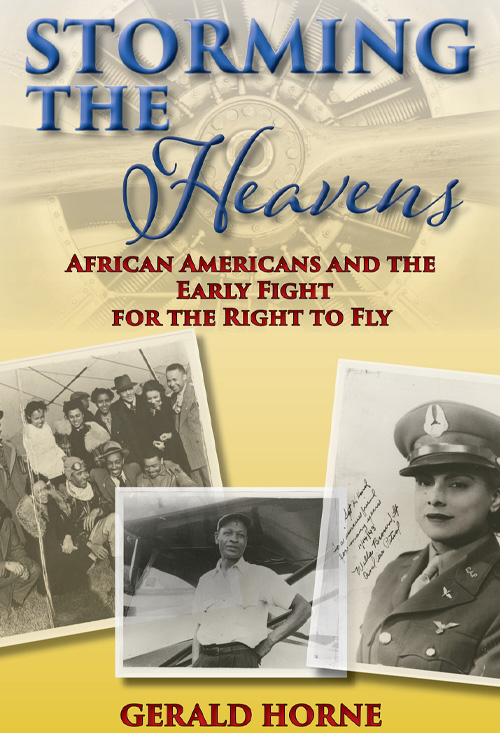
Storming the Heavens : African Americans and the Early Fight for the Right to Fly
Gerald Horne
The Hollywood film 'Hidden Figures' presents a portrait of how African-American women shaped the U.S. effort in aerospace during the height of Jim Crow. In Storming the Heavens, Gerald Horne presents the necessary back story to this story and goes further to detail the earlier struggle of African-Americans to gain the right to fly.
This struggle involved pioneers like Bessie Coleman, who traveled to World War I era Paris in order to gain piloting skills that she was denied in her U.S. homeland; and John Robinson, from Chicago via Mississippi, who traveled to 1930s Ethiopia where he was the leading pilot for this beleaguered African nation as it withstood an invasion from fascist Italy, became the personal pilot of His Imperial Majesty, Haile Selassie and became a founder of Ethiopian Airways, which to this very day is Africa's most important carrier. Additionally, Horne adds nuance to the oft told tale of the Tuskegee Airmen but goes further to discuss the role of U.S. pilots during the Korean war in the early 1950s. He also tells the story of how and why U.S. airlines were fought when they began to fly into South Africa—and how planes from this land of apartheid were protested when they landed at U.S. airports.
This riveting story climaxes with the launching of the Soviet satellite, Sputnik, in 1957 which marked a new stage in the battle for aerospace and helps to convince the U.S. that the centuries-long fixation on the "race race" was hampering the new challenge represented by the "space race." This conflict was unfolding as the battle to desegregate public schools in Little Rock, Arkansas was spotlighting, globally, the bleeding wound that was Jim Crow and sheds light on how and why depriving African-Americans of skills and education was causing the nation to fall behind. Thus, in this embattled context, barriers are broken and African-Americans who once endured inferior conditions on planes and in airports and in airport manufacturing facilities alike, gained added impetus in their decades long struggle to win the right to fly.

Facing the Rising Sun : African Americans, Japan, and the Rise of Afro-Asian Solidarity. New York University Press, 2018
Gerald Horne
In November 1942 in East St. Louis, Illinois a group of African Americans engaged in military drills were eagerly awaiting a Japanese invasion of the U.S.— an invasion that they planned to join. Since the rise of Japan as a superpower less than a century earlier, African Americans across class and ideological lines had saluted the Asian nation, not least because they thought its very existence undermined the pervasive notion of “white supremacy.”
The list of supporters included Booker T. Washington, Marcus Garvey, and particularly W.E.B. Du Bois. Facing the Rising Sun tells the story of the widespread pro-Tokyo sentiment among African Americans during World War II, arguing that the solidarity between the two groups was significantly corrosive to the U.S. war effort. Gerald Horne demonstrates that Black Nationalists of various stripes were the vanguard of this trend—including followers of Garvey and the precursor of the Nation of Islam. Indeed, many of them called themselves “Asiatic”, not African. Following World War II, Japanese-influenced “Afro-Asian” solidarity did not die, but rather foreshadowed Dr. Martin Luther King’s tie to Gandhi’s India and Black Nationalists’ post-1970s fascination with Maoist China and Ho’s Vietnam.
Based upon exhaustive research, including the trial transcripts of the pro-Tokyo African Americans who were tried during the war, congressional archives and records of the Negro press, this book also provides essential background for what many analysts consider the coming “Asian Century.” An insightful glimpse into the Black Nationalists’ struggle for global leverage and new allies, Facing the Rising Sun provides a complex, holistic perspective on a painful period in African American history, and a unique glimpse into the meaning of “the enemy of my enemy is my friend.”
2017

En Pos de La Revolución. Editorial de Ciencias Sociales, 2017
Gerald Horne
No summary found.
Claustrofobias (Promociones literarias)

Race war: white supremacy and the Japanese attack on the British Empire
Gerald Horne
During World War II, the Japanese military launched a brutal and blitzkrieg-style attack on Asia. How did Japan rationalize its colonial policies in Asia and gain support from its colonized nations? This book explores how Japan used European racism and colonial policies to forge alliances in countries of color. Through interviews and historical research, the author analyzes five continents and explains how "race" played a crucial role in war. During the war, Japan redefined the European concept of white supremacy, portraying the Pacific War as a racial war waged by whites against Asia. Japan proposed a new racial hierarchy, placing China, Korea, and India above Western countries and pursuing colonial liberation—a definition inevitably forgotten after its defeat.
Reading Republic Publishing Group
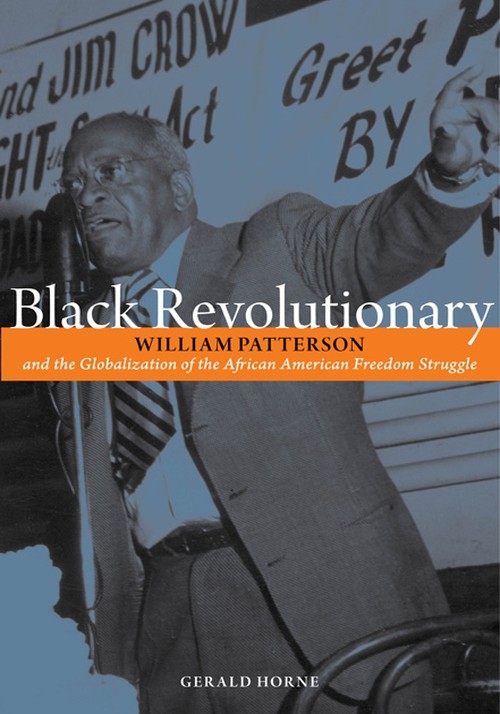
Black Revolutionary: William Patterson and the Globalization of the African American Freedom Struggle
Gerald Horne
A leading African American Communist, lawyer William L. Patterson (1891–1980) was instrumental in laying the groundwork for the defeat of Jim Crow by virtue of his leadership of the Scottsboro campaign in the 1930s. In this watershed biography, historian Gerald Horne shows how Patterson helped to advance African American equality by fostering and leveraging international support for the movement. Horne highlights key moments in Patterson's global activism: his early education in the Soviet Union, his involvement with the Scottsboro trials and other high-profile civil rights cases of the 1930s to 1950s, his 1951 "We Charge Genocide" petition to the United Nations, and his later work with prisons and the Black Panther Party. Through Patterson's story, Horne examines how the Cold War affected the freedom movement, with civil rights leadership sometimes disavowing African American leftists in exchange for concessions from the U.S. government. He also probes the complex and often contradictory relationship between the Communist Party and the African American community, including the impact of the FBI's infiltration of the Communist Party. Drawing from government and FBI documents, newspapers, periodicals, archival and manuscript collections, and personal papers, Horne documents Patterson's effectiveness at carrying the freedom struggle into the global arena and provides a fresh perspective on twentieth-century struggles for racial justice.

The Rise and Fall of the Associated Negro Press: Claude Barnett’s Pan-African News and the Jim Crow Paradox
Gerald Horne
For nearly fifty years, the Chicago-based Associated Negro Press (ANP) fought racism at home and grew into an international news organization abroad. At its head stood founder Claude Barnett, one of the most influential African Americans of his day and a gifted, if unofficial, diplomat who forged links with figures as diverse as Jawaharlal Nehru, Zora Neale Hurston, and Richard Nixon. Gerald Horne weaves Barnett's fascinating life story through a groundbreaking history of the ANP, including its deep dedication to Pan-Africanism. An activist force in journalism, Barnett also helped send doctors and teachers to Africa, advised African governments, gave priority to foreign newsgathering, and saw the African American struggle in global terms. Yet Horne also confronts Barnett's contradictions. A member of the African American elite, Barnett's sympathies with black aspirations often clashed with his ethics and a powerful desire to join the upper echelons of business and government. In the end, Barnett's activist success undid his work. Horne traces the dramatic story of the ANP's collapse as the mainstream press, retreating from Jim Crow, finally covered black issues and hired African American journalists.

The Apocalypse of Settler Colonialism : The Roots of Slavery, White Supremacy, and Capitalism in Seventeenth-Century North America and the Caribbean
Gerald Horne
Chronicles how American culture - deeply rooted in white supremacy, slavery and capitalism - finds its origin story in the 17th century European colonization of Africa and North America, exposing the structural origins of American "looting" Virtually no part of the modern United States—the economy, education, constitutional law, religious institutions, sports, literature, economics, even protest movements—can be understood without first understanding the slavery and dispossession that laid its foundation. To that end, historian Gerald Horne digs deeply into Europe’s colonization of Africa and the New World, when, from Columbus’s arrival until the Civil War, some 13 million Africans and some 5 million Native Americans were forced to build and cultivate a society extolling “liberty and justice for all.” The seventeenth century was, according to Horne, an era when the roots of slavery, white supremacy, and capitalism became inextricably tangled into a complex history involving war and revolts in Europe, England’s conquest of the Scots and Irish, the development of formidable new weaponry able to ensure Europe’s colonial dominance, the rebel merchants of North America who created “these United States,” and the hordes of Europeans whose newfound opportunities in this “free” land amounted to “combat pay” for their efforts as “white” settlers.
2016

Osmanlilar ve Memluklar: Islam Dunyasinda Imparatorluk Diplomasisi ve Rekabet (Kitap Yayinevi, 2016)
Emire Cihan Yuksel
Turkish Translation of "The Ottomans and the Mamluks."

Fighting in Paradise : Labor Unions, Racism, and Communists in the Making of Modern Hawai’i. University of Hawai’i Press, 2016
Gerald Horne
Powerful labor movements played a critical role in shaping modern Hawaii, beginning in the 1930s, when International Longshore and Warehousemen’s Union (ILWU) representatives were dispatched to the islands to organize plantation and dock laborers. They were stunned by the feudal conditions they found in Hawaii, where the majority of workers—Hawaiian, Japanese, Chinese, and Filipino in origin—were routinely subjected to repression and racism at the hands of white bosses. The wartime civil liberties crackdown brought union organizing to a halt; but as the war wound down, Hawaii workers’ frustrations boiled over, leading to an explosive success in the forming of unions. During the 1950s, just as the ILWU began a series of successful strikes and organizing drives, the union came under McCarthyite attacks and persecution. In the midst of these allegations, Hawaii’s bid for statehood was being challenged by powerful voices in Washington who claimed that admitting Hawaii to the union would be tantamount to giving the Kremlin two votes in the U.S. Senate, while Jim Crow advocates worried that Hawaii’s representatives would be enthusiastic supporters of pro–civil rights legislation.

Negro Comrades of the Crown : African Americans and the British Empire Fight the U.S. Before Emancipation
Gerald Horne
While it is well known that more Africans fought on behalf of the British than with the successful patriots of the American Revolution, Gerald Horne reveals in his latest work of historical recovery that after 1776, Africans and African-Americans continued to collaborate with Great Britain against the United States in battles big and small until the Civil War. Many African Americans viewed Britain, an early advocate of abolitionism and emancipator of its own slaves, as a powerful ally in their resistance to slavery in the Americas. This allegiance was far-reaching, from the Caribbean to outposts in North America to Canada. In turn, the British welcomed and actively recruited both fugitive and free African Americans, arming them and employing them in military engagements throughout the Atlantic World, as the British sought to maintain a foothold in the Americas following the Revolution. In this path-breaking book, Horne rewrites the history of slave resistance by placing it for the first time in the context of military and diplomatic wrangling between Britain and the United States. Painstakingly researched and full of revelations, Negro Comrades of the Crown is among the first book-length studies to highlight the Atlantic origins of the Civil War, and the active role played by African Americans within these external factors that led to it.
2015
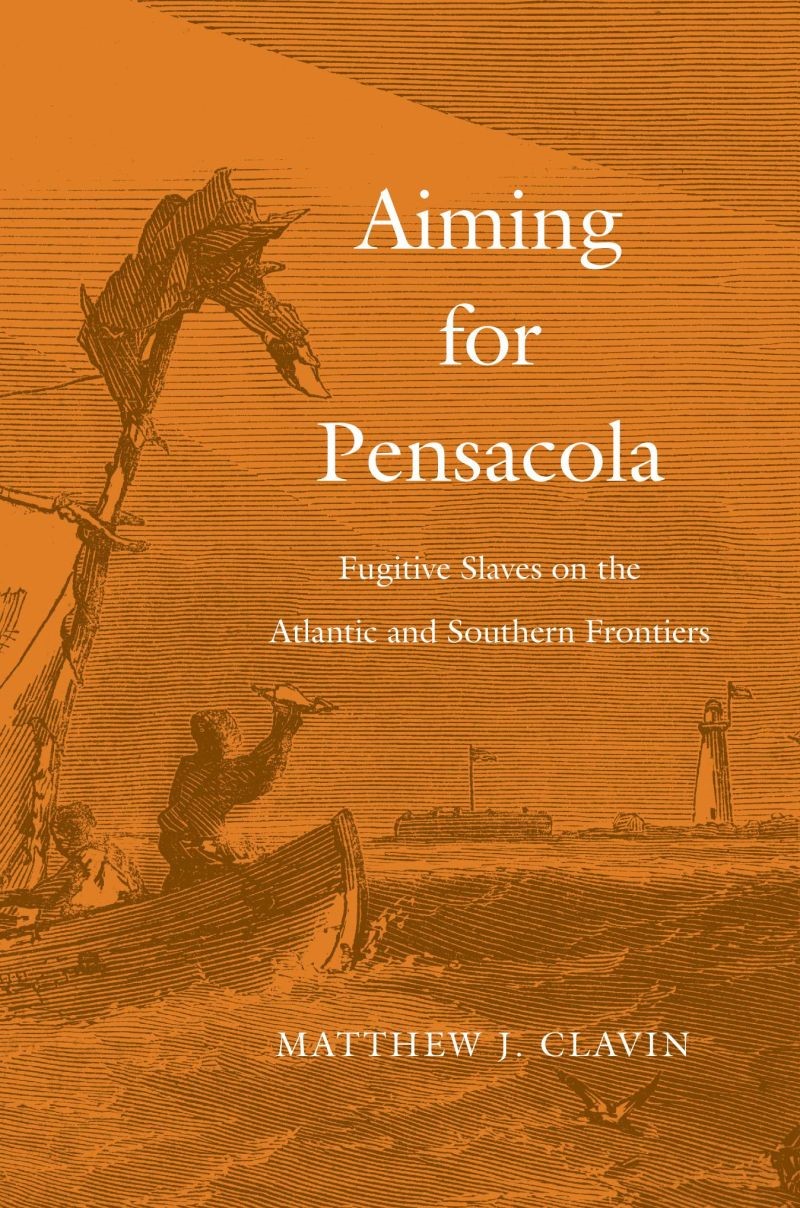
Aiming for Pensacola: Fugitive Slaves on the Atlantic and Southern Frontiers
Matthew J. Clavin
In the decades before the Civil War, the small number of slaves who managed to escape bondage almost always made their way northward along the secret routes and safe havens known as the Underground Railroad. Offering a new perspective on this standard narrative, Matthew Clavin recovers the story of fugitive slaves who sought freedom by―paradoxically―sojourning deeper into the American South toward an unlikely destination: the small seaport of Pensacola, Florida. Geographically and culturally, across decades of rule by a succession of powers―Spain, Great Britain, and the United States―Pensacola occupied an isolated position on the margins of antebellum Southern society. Yet as neighboring Gulf Coast seaports like New Orleans experienced rapid population growth and economic development based on racial slavery, Pensacola became known for something else: as an enclave of diverse, free peoples of European, African, and Native American descent. Farmers, laborers, mechanics, soldiers, and sailors learned to cooperate across racial lines and possessed no vested interest in maintaining slavery or white supremacy. Clavin examines how Pensacola’s reputation as a gateway to freedom grew in the minds of slaves and slaveowners, and how it became a beacon for fugitives who found northern routes to liberation inaccessible.

Workers Go Shopping in Argentina: The Rise of Popular Consumer Culture
Natalia Milanesio
Combining theories from the anthropology of consumption, cultural studies, and gender studies with the methodologies of social, cultural, and oral histories, Milanesio shows the exceptional cultural and social visibility of low-income consumers in postwar Argentina along with their unprecedented economic and political influence.
University of New Mexico Press

From the Barrel of a Gun : The United States and the War against Zimbabwe, 1965-1980. University of North Carolina Press, 2015
Gerald Horne
In November 1965, Ian Smith’s white minority government in Southern Rhodesia (now Zimbabwe) made a unilateral declaration of independence, breaking with Great Britain. With a European population of a few hundred thousand dominating an African majority of several million, Rhodesia’s racial structure echoed the apartheid of neighboring South Africa. Smith’s declaration sparked an escalating guerrilla war that claimed thousands of lives. Across the Atlantic, President Lyndon B. Johnson nervously watched events in Rhodesia, fearing that racial conflict abroad could inflame racial discord at home. Although Washington officially voiced concerns over human rights violations, an attitude of tolerance generally marked U.S. relations with the Rhodesian government: sanctions were imposed but not strictly enforced, and hundreds, perhaps thousands, of American mercenaries joined white Rhodesia’s side in battle with little to fear from U.S. laws. Despite such tacit U.S. support, Smith’s regime fell in 1980, and the independent state of Zimbabwe was born. The first comprehensive account of American involvement in the war against Zimbabwe, this compelling work also explores how our relationship with Rhodesia helped define interracial dynamics in the United States, and vice versa.
University of North Carolina Press

Confronting Black Jacobins: The United States, the Haitian Revolution, and the Origins of the Dominican Republic. Monthly Review Press, 2015
Gerald Horne
The Haitian Revolution, the product of the first successful slave revolt, was truly world-historic in its impact. When Haiti declared independence in 1804, the leading powers—France, Great Britain, and Spain—suffered an ignominious defeat and the New World was remade. The island revolution also had a profound impact on Haiti’s mainland neighbor, the United States. Inspiring the enslaved and partisans of emancipation while striking terror throughout the Southern slaveocracy, it propelled the fledgling nation one step closer to civil war. Gerald Horne’s path breaking new work explores the complex and often fraught relationship between the United States and the island of Hispaniola. Giving particular attention to the responses of African Americans, Horne surveys the reaction in the United States to the revolutionary process in the nation that became Haiti, the splitting of the island in 1844, which led to the formation of the Dominican Republic, and the failed attempt by the United States to annex both in the 1870s. Drawing upon a rich collection of archival and other primary source materials, Horne deftly weaves together a disparate array of voices—world leaders and diplomats, slaveholders, white abolitionists, and the freedom fighters he terms Black Jacobins. Horne at once illuminates the tangled conflicts of the colonial powers, the commercial interests and imperial ambitions of U.S. elites, and the brutality and tenacity of the American slaveholding class, while never losing sight of the freedom struggles of Africans both on the island and on the mainland, which sought the fulfillment of the emancipatory promise of 18th century republicanism.
2014

Medicine and Empire; 1600-1960 (Palgrave Macmillan, 2014)
Pratik Chakrabarti
The history of modern medicine is inseparable from the history of imperialism. Medicine and Empire provides an introduction to this shared history – spanning three centuries and covering British, French and Spanish imperial histories in Africa, Asia and America. Exploring the major developments in European medicine from the seventeenth century to the mid-twentieth century, Pratik Chakrabarti shows that the major developments in European medicine had a colonial counterpart and were closely intertwined with European activities overseas: - The increasing influence of natural history on medicine - The growth of European drug markets - The rise of surgeons in status - Ideas of race and racism - Advancements in sanitation and public health - The expansion of the modern quarantine system - The emergence of Germ theory and global vaccination campaigns Drawing on recent scholarship and primary texts, this book narrates a mutually constitutive history in which medicine was both a 'tool' and a product of imperialism, and provides an original, accessible insight into the deep historical roots of the problems that plague global health today.

The Counter-Revolution of 1776 : Slave Resistance and the Origins of the United States of America. First paperback [edition]
Gerald Horne
The successful 1776 revolt against British rule in North America has been hailed almost universally as a great step forward for humanity. But the Africans then living in the colonies overwhelmingly sided with the British. In this trailblazing book, Gerald Horne shows that in the prelude to 1776, the abolition of slavery seemed all but inevitable in London, delighting Africans as much as it outraged slaveholders, and sparking the colonial revolt. Prior to 1776, anti-slavery sentiments were deepening throughout Britain and in the Caribbean, rebellious Africans were in revolt. For European colonists in America, the major threat to their security was a foreign invasion combined with an insurrection of the enslaved. It was a real and threatening possibility that London would impose abolition throughout the colonies—a possibility the founding fathers feared would bring slave rebellions to their shores. To forestall it, they went to war.

Muslu, The Ottomans and The Mamluks: Imperial Diplomacy and Warfare in the Islamic World
Cihan Yuksel
Beginning on the eve of Oceanic exploration, and the first European forays into the Indian Ocean and the Middle East, the relationship between the Sunni Muslim Ottomans and the Sunni Muslim Mamluks unfolded amidst the transformation of the Ottoman principality in Anatolia into a world power and the relative decline of the Mamluks who were the superpowers in Egypt and Syria and the historic custodians of Mecca and Medina. This is the first detailed study in English of one of the most important political and cultural relationships in early-modern Islamic geography, viewed through the lens of diplomatic history. Cihan Yüksel traces the intertwined stories of these two dominant Sunni Muslim empires of the early modern world, setting out to show the complexity of diplomatic culture and communication within the Islamic world before the rise of modern diplomacy in the Western European world. Through the analysis of their diplomatic repertoire and engagements until 1481, Yüksel shows that these two Islamic super-powers had developed and sustained a long and multilayered communication since the fourteenth century, long before the Ottoman defeat of Mamluk regime in 1516-1517 transformed the story of their encounters into one of Ottoman military superiority and victory.
The Ottomans and the Mamluks: Imperial Diplomacy and Warfare (I.B. Tauris, 2014)
Cihan Yuksel
Beginning on the eve of Oceanic exploration, and the first European forays into the Indian Ocean and the Middle East, the relationship between the Sunni Muslim Ottomans and the Sunni Muslim Mamluks unfolded amidst the transformation of the Ottoman principality in Anatolia into a world power and the relative decline of the Mamluks who were the superpowers in Egypt and Syria and the historic custodians of Mecca and Medina. This is the first detailed study in English of one of the most important political and cultural relationships in early-modern Islamic geography, viewed through the lens of diplomatic history. Cihan Yüksel traces the intertwined stories of these two dominant Sunni Muslim empires of the early modern world, setting out to show the complexity of diplomatic culture and communication within the Islamic world before the rise of modern diplomacy in the Western European world. Through the analysis of their diplomatic repertoire and engagements until 1481, Yüksel shows that these two Islamic super-powers had developed and sustained a long and multilayered communication since the fourteenth century, long before the Ottoman defeat of Mamluk regime in 1516-1517 transformed the story of their encounters into one of Ottoman military superiority and victory.
2012

Bacteriology in British India Laboratory Medicine and the Tropics
Pratik Chakrabarti
During the nineteenth century, European scientists and physicians considered the tropics the natural home of pathogens. Hot and miasmic, the tropical world was the locus of disease, for Euopeans the great enemy of civilization. Inthe late nineteenth century when bacteriological laboratories and institutions were introduced to British India, they were therefore as much an imperial mission to cleanse and civilize a tropical colony as a medical one to eradicate disease. Bacteriology offered a panacea in colonial India, a way by which the multifarious political, social, environmental, and medical problems and anxieties, intrinsically linked to its diseases, could have a single resolution. Bacteriology in British India is the first book to provide a social and cultural history of bacteriology in colonial India, situating it within the confluence of advances in germ theory, Pastuerian vaccines, colonial medicine, laboratory science, and British imperialism. It recounts the genesis of bacteriology and laboratory medicine in India through a complex history of conflict and alignment between Pasteurism and British imperial medicine. By investigating an array of laboratory notes, medical literature, and literary sources, the volume links colonial medical research with issues of poverty, race, nationalism, and imperial attitudes toward tropical climate andwildlife, contributing to a wide field of scholarship like the history of science and medicine, sociology of science, and cultural history.

J. Edgar Hoover Goes to the Movies: The FBI and the Origins of Hollywood's Cold War
John Sbardellati
Between 1942 and 1958, J. Edgar Hoover's Federal Bureau of Investigation conducted a sweeping investigation of the film industry to expose Hollywood's alleged subversion of "the American Way" through its depiction of social problems, class differences, and alternative political ideologies. FBI informants (their names still redacted today) reported to Hoover's G-men on screenplays and screenings of such films as Frank Capra's It's a Wonderful Life (1946), noting that "this picture deliberately maligned the upper class attempting to show that people who had money were mean and despicable characters." The FBI's anxiety over this film was not unique; it extended to a wide range of popular and critical successes, including The Grapes of Wrath (1940), The Best Years of Our Lives (1946), Crossfire (1947) and On the Waterfront (1954). In J. Edgar Hoover Goes to the Movies, John Sbardellati provides a new consideration of Hollywood's history and the post–World War II Red Scare. Sbardellati argues that the attack on Hollywood drew its motivation from the fear that movies actually endangered national security, and he details how and why Hollywood became one of the most important ideological battlegrounds of the Cold War.