
NSM In Space
Exploring the universe. Advancing discovery. Preparing the next generation of space innovators.
Houston is known around the world as Space City. And while astronauts may be the most recognizable faces of space exploration, they represent only one part of the work it takes to explore our universe.
Behind every mission are scientists studying distant planets, physicists examining the forces that shape our universe and computer scientists analyzing complex data. As Houston’s space industry continues to grow, so does the need for people with the knowledge and skills to support this work.
At the University of Houston College of Natural Sciences and Mathematics (NSM), our faculty and students are exploring questions that reach far beyond Earth. Through research, classroom learning and hands-on experiences, they are contributing to our understanding of the universe while building skills that can open doors to careers across the space industry and other STEM fields.
Explore the people, research and experiences connecting NSM to the future of space.
Exploring Space Through Research
Space exploration takes more than one kind of scientist. At NSM, researchers investigate planetary materials, study the effects of spaceflight on living systems and explore questions about planetary environments and the fundamental physics of our universe. Their work connects scientific questions about space with research that can inform future exploration.

What can rocks and minerals from other worlds tell us about the history of our own planet?
NSM researchers study meteorites, planetary materials and the geological processes that shape planetary surfaces. By examining materials from Mars, the moon and the asteroid belt, they investigate how planets formed and changed over time, uncovering clues about Earth’s early history that may no longer be preserved in its rocks.
This research also helps scientists piece together the geological history of other worlds, including how volcanic activity and impacts have shaped the surface of Mars.
Their expertise extends to impact sites and Mars-like landscapes on Earth, where geological fieldwork helps prepare scientists and technology for planetary exploration. NSM students have applied their geological expertise to testing robotic rovers in simulated Martian environments, helping evaluate how these technologies could support rock sampling and other fieldwork on future planetary missions.
How do the conditions of space affect the microorganisms that live alongside us?
Preparing for human spaceflight requires understanding not only how space affects astronauts, but also how it affects the microorganisms that accompany them. Among these are biofilms — communities of microorganisms that grow together and can influence human health.
Through NASA-backed research, NSM scientists are helping investigate how conditions associated with spaceflight, including altered gravity and increased radiation, may affect these microbial communities. Their work identifies important gaps in our understanding of biofilms in space and explores how this knowledge could help address risks to astronaut health while informing future applications in drug delivery and space agriculture.
How can scientists help prevent Earth’s microorganisms from traveling to other worlds?
Even in the carefully controlled clean rooms where spacecraft are assembled, some bacteria can survive. NSM researchers are studying how these microorganisms persist and how scientists can better detect them before a spacecraft leaves Earth.
In one study, UH researchers found that a bacterium isolated from a spacecraft assembly clean room can enter a dormant state under nutrient-poor conditions and later resume growing. Understanding this survival strategy could help improve methods for detecting microbial contamination and inform planetary protection practices for future missions.
How can computing technologies help astronauts prepare for the challenges of exploring other worlds?
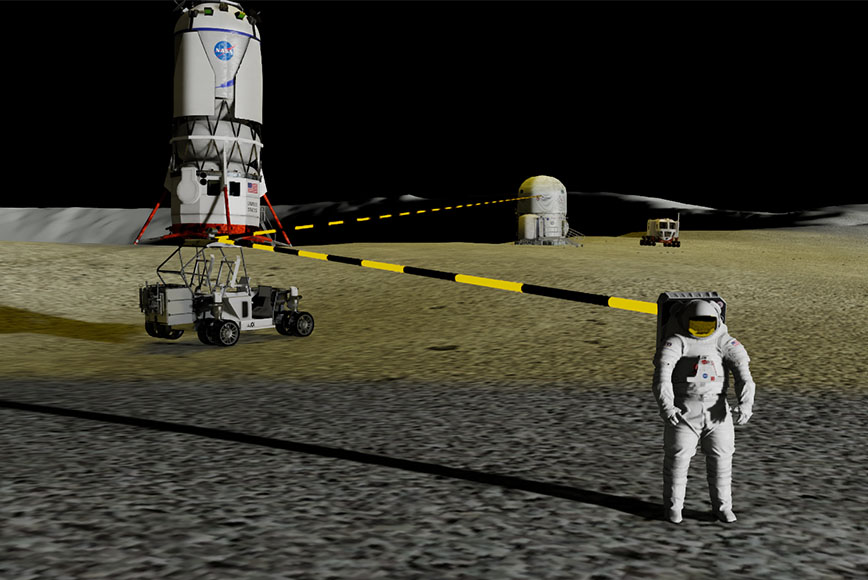
NSM researchers are helping develop immersive technologies designed to prepare astronauts for complex tasks in space. Through a NASA-funded collaboration with a Houston-based technology company, UH Computer Science faculty and students are contributing to augmented and virtual reality tools that simulate activities on the moon and Mars.
Building on earlier work in medical training, the project combines immersive environments with software designed to interpret natural language, with the goal of helping astronauts practice critical procedures and prepare for future missions.
From the Classroom to the Field & Beyond
For NSM students, an interest in space can lead to experiences far beyond a traditional classroom. Through field investigations, scientific instrumentation, professional internships and astronomical observation, students can apply what they learn while gaining experience with the questions and tools that drive research and exploration.

Earth and Atmospheric Sciences students gain experience studying geological environments that can help scientists understand other worlds. Field experiences at sites such as Sierra Madera in Texas and Meteor Crater in Arizona offer opportunities to examine geological features and processes relevant to planetary science.
What does it take to design an instrument, prepare it for field testing and collect scientific data in Alaska?
Through the Undergraduate Student Instrument Project (USIP), NSM students have worked together to develop and test instruments that investigate Earth’s upper atmosphere and phenomena such as the aurora. The multidisciplinary, two-year, for-credit program brings students into the research process, from instrument design and problem-solving to field preparation and data collection. Students have tested ground-based and balloon-borne equipment in Alaska, gaining experience with the challenges of conducting research outside the laboratory.
NSM students can participate in NASA’s Spacesuit User Interface Technologies for Students (SUITS) challenge, which invites college teams to design user interface solutions for future spaceflight needs. The challenge focuses on technologies that could help astronauts carry out tasks during exploration of the moon and Mars. Through SUITS, students apply their computing and design skills to challenges associated with human space exploration.
What if your college experience could include working alongside the people behind NASA’s missions?
NSM students have taken their academic and research experience beyond the university through opportunities with NASA and contractors at Johnson Space Center. Through programs such as NASA’s Pathways Internship Program, students have applied the scientific and technical skills developed at UH while gaining firsthand experience in the work of space exploration.
These experiences have allowed students to connect their classroom learning and research with professional work, explore different areas of NASA and see how their expertise can contribute to fields such as planetary science and future space exploration.
Students do not have to leave campus to begin exploring the night sky.
Located on the roof of Science and Research Building 1, the Department of Physics’ observatory provides a setting for astronomical observation and learning. The Astronomy Society at UH also brings together students and others who share an interest in astronomy.
Explore Space Through Your Studies
A career connected to the space industry can begin in many different classrooms.
Whether your interests lie in planetary science, physics, computing or chemistry, NSM offers academic experiences that can help you build the knowledge and skills to pursue opportunities in space-related fields.
Students can explore topics directly connected to space through specialized coursework while developing broader expertise in disciplines that support scientific research, technology and exploration.

From the surface of a distant planet to the atmosphere surrounding it, understanding other worlds begins with understanding the geological and physical processes that shape them.
Through courses such as Exploring the Planets, Planetary Materials and Remote Sensing, students can examine planetary environments and develop skills used to study Earth and other worlds.
Physics provides a foundation for understanding the principles that govern matter, energy and motion, from the smallest particles to the larger universe.
Students interested in space science can explore how these principles relate to astronomy, planetary environments and the scientific instruments used to study them.
Space exploration also depends on expertise beyond planetary science and physics. Mathematicians develop models that help scientists calculate spacecraft trajectories and interpret mission data. In Computer Science, expertise in human-centered robotics, quantum computing, and high-performance and scientific computing can contribute to challenges such as autonomous systems and the analysis of mission data. Chemists study materials and chemical reactions relevant to spacecraft, planetary environments and the search for signs of life. Biologists investigate how living systems respond to conditions such as microgravity and radiation.
Together, these disciplines illustrate the range of scientific and technical work behind space exploration and the different directions NSM students may pursue as they build their careers.
Connected to the Space Community
NSM’s work takes place within a region where universities, NASA and a growing network of research and technology organizations contribute to space exploration. Universitywide agreements and educational networks provide additional connections to that broader community.

Space Act Agreement
The University of Houston System entered into a Space Act umbrella agreement with NASA’s Johnson Space Center to establish a framework for collaboration in research, technology development, education and outreach. Specific collaborative activities are established through separate agreements.
University Membership
The University of Houston is a member of the Texas Space Grant Consortium, a network of more than 50 institutions working to expand access to space research, education and technology across Texas.
Through its programs, the consortium offers opportunities for eligible students to explore space-related fields through research, design challenges, scholarships and hands-on learning experiences.
Global Research Alliance
In 2026, the University of Houston joined Axiom Space’s University Alliance, a global network of 26 institutions across four continents working to advance microgravity research, technology development and the future of space exploration.
The alliance connects researchers, engineers and students with an international community focused on identifying research opportunities, fostering collaboration and supporting the next generation of space missions.
A Legacy of Discovery

As the University of Houston and the College of Natural Sciences and Mathematics mark their centennial and 50th anniversary, respectively, in 2027, NSM’s history offers a look at the researchers and educators who helped connect the university to space exploration.
In the Department of Earth and Atmospheric Sciences, Elbert Aubrey King worked with NASA’s lunar samples, while Kevin Burke and Arch Reid held leadership roles at the Lunar and Planetary Institute. Their contributions reflect a longstanding connection between the study of Earth and the exploration of other worlds.

NSM’s connection to space-based research also includes Alex Ignatiev, a former UH professor of physics who led the Wake Shield Facility program. Designed and built by UH’s Space Vacuum Epitaxy Center, the facility flew on three space shuttle missions between 1994 and 1996. It used the unusually clean vacuum created behind a platform orbiting Earth to grow thin-film materials, demonstrating a new approach to conducting materials research in space.
NSM’s legacy in space exploration also extends through its alumni. Bernard Harris, who earned his bachelor’s degree in biology from UH in 1978, became the first African American to walk in space during a 1995 Space Shuttle Discovery mission. His career at NASA combined space exploration with medical research, including work on health-related technologies for astronauts.
The university’s history of space education includes astronaut Bonnie Dunbar, who previously led the UH STEM Center, an initiative established through collaboration between NSM and the Cullen College of Engineering.
These contributions are part of the rich history NSM carries into its next chapter, as today’s faculty and students continue exploring questions about Earth, space and the universe beyond.
Explore Space Through Our Experts
Behind NSM’s space-related research are faculty whose work spans planetary geology, atmospheric science, physics, astrobiology and other fields. Meet the people investigating questions about Earth, our universe and the worlds beyond it.
Planetary Science & Exploration

Michael Antonelli
Earth and Atmospheric Sciences
Faculty Profile ›
Cosmochemistry and isotope geochemistry

Qi Fu
Earth and Atmospheric Sciences
Faculty Profile ›
Organic geochemistry, carbonate formation and Mars

Jinping Hu
Earth and Atmospheric Sciences
Faculty Profile ›
Planetary materials, impact processes and shock-wave dynamics

Thomas Lapen
Earth and Atmospheric Sciences
Faculty Profile ›
Planetary geology, cosmochemistry and early solar system materials

Robert Stewart
Earth and Atmospheric Sciences
Faculty Profile ›
Planetary geophysics and terrestrial impact sites

Yingcai Zheng
Earth and Atmospheric Sciences
Faculty Profile ›
Planetary seismology, seismic imaging and rock physics

Xun Jiang
Earth and Atmospheric Sciences
Faculty Profile ›
Planetary atmospheres and atmospheric dynamics

Liming Li
Physics
Faculty Profile ›
Planetary atmospheres, spacecraft observations and modeling
Space Physics & Astronomy

Edgar Bering
Physics
Faculty Profile ›
Upper-atmosphere physics, space plasma and advanced space propulsion

Andrew Renshaw
Physics
Faculty Profile ›
Particle detectors, dark matter and neutrino physics

Gemunu Gunaratne
Physics
Faculty Profile ›
Complex physical systems and astronomical observation
Space Technologies & Exploration Systems

Jakoah Brgoch
Chemistry
Faculty Profile ›
Advanced inorganic materials for extreme environments

Steven Baldelli
Chemistry
Faculty Profile ›
Surface chemistry and materials for extreme environments
Wei-Kan Chu
Physics
Faculty Profile ›
Ion beams, radiation effects and advanced materials

Nikolaos V. Tsekos
Computer Science
Faculty Profile ›
Augmented and virtual reality technologies for astronaut training
Astrobiology & Planetary Protection

George E. Fox
Biology and Biochemistry
Faculty Profile ›
Microbial evolution, extreme environments and planetary protection

William Widger
Biology and Biochemistry
Faculty Profile ›
Microbial dormancy, spacecraft contamination and planetary protection

Preethi Gunaratne
Biology and Biochemistry
Faculty Profile ›
Genomics, systems biology and molecular analysis
Earth Observation & Remote Sensing

Shuhab Khan
Earth and Atmospheric Sciences
Faculty Profile ›
Remote sensing, geophysical technologies and Earth observation
Latest Space News
Meet the NSM students and faculty whose research, achievements and experiences connect our college to space science. Explore their stories to learn more.


The Future of Space Starts Here
There is no single path into the future of space exploration. Some students may go on to study distant planets or investigate the fundamental physics of our universe. Others may apply their skills in STEM fields to challenges that extend well beyond space.
At NSM, students can begin building those foundations through their studies, research and experiences alongside faculty who are asking questions about our world and what lies beyond it.
Explore where your interests can take you.
Discover NSM