RAPID Survey
The RAPID-Harris County Survey Project
Three-Year Cumulative Report
This report provides an overview of the findings of the UH-IRWGS work on the 3-year RAPID-HC survey project for HCDEEO, including both the 2023-2024 phase in collaboration with Stanford University and the 2025 study of the needs and concerns of immigrant families.
RAPID-HC Immigrant & Refugee Parents Fact Sheet (March 2026)
RAPID Fact Sheet March 2026 Spanish Español
This report explores the experience of the families of the 41% of Harris County children under 6 with at least one immigrant parent (ACS 2024), based on 373 surveys and 40 interviews. In 2024 roughly 28% of the Harris County population were immigrants, filling jobs that would otherwise stand empty in such sectors as construction, agriculture, hospitality, food service and janitorial services, healthcare and caregiving, as well as in highly skilled fields including technology, engineering, and research (CPS), expanding the local economy. While they supply current workforce needs, immigrants also help build the workforce of the future: in 2023 the fertility rate for non-immigrant women was 52 births/1000 women aged 15-44, in contrast for immigrant women it was 66/1000 (27% higher) [estimate based on CDC and Census data].
Previously, UH IRWGS identified that immigrant families had less child care access than other groups because many families’ grandparents are abroad, which impedes mothers’ workforce participation. (In Harris County 48% of foreign-born mothers are employed vs. 68% of native-born mothers, with an additional 6% of both groups looking for work [ACS 2024]). The data reported here provides insight into the circumstances and concerns of the large proportion of immigrant mothers unable to work due to barriers, enabling Harris County to identify areas of need for targeted workforce support.
RAPID Survey Fact Sheet: Actualities & Aspirations (December 2025)
UH-IRWGS Dec 2025 RAPID-HC Fact Sheet, Spanish Español
RAPID-Harris County Data Update Many Young Families Face Stress - April 2025
RAPID-Harris County Data Update - October 2024
RAPID-Harris County-UH IRWGS
Survey of Family and Child Wellbeing
About Us
RAPID Harris County asks parents of young children about what they’re experiencing, to hear parents’ voices, and better understand how we can serve families in our community. RAPID is an ongoing survey of households with children ages 0 to 5, designed to gather essential information on the needs and well-being of children and their families.



RAPID-Harris County Update
June 2024
More than 1200 Harris County parents/primary caregivers with children aged five and younger have told us something about their successes and challenges, since we started asking in March 2023.
As we go, we want to share our findings with you! Here’s some of what we learned so far:
CHILDCARE GAPS
57% of Harris County RAPID respondents have kids in Non-Parental Childcare [NPCC],
at a Center or with a Relative, while parents work.
Since center-based childcare is often expensive,
it’s mostly used by families with higher incomes.
Lower-income families often depend on relatives for NPCC.
But 42% of parents of kids under 5 in Harris County are immigrants!
And many immigrants don’t have relatives here.
That helps explain why they’re roughly 18-22% less likely to use Non-Parental Childcare.
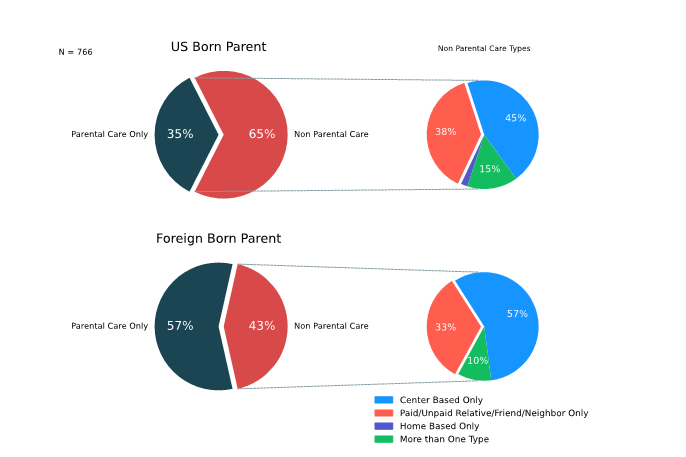
often isolating them and their kids at home and making them more vulnerable to abuse.
That means less money spent in community businesses.
Suggesting a need for expanded affordable center-based care.
- Blacks and Hispanics reported more difficulty paying for basics than Whites with similar
income.
- Suggesting that their social support networks had fewer resources to share (such as savings, property/assets, space, time to babysit, etc.).
- This may be linked in part to historical and current inequities in wages and access to services.
- Respondents in Spanish reported less debt (perhaps linked to lower access to credit).
Parent Voices
There is strength in shared experience and we value your insight.
We want to hear what challenges you face, what is helping you, and what you want leaders
to know about their situation.
We use your feedback to understand the highs and lows families are experiencing.
What is helping you and your family the most right now?
- Our family’s childcare is provided by my mother … What we pay her is far less than what we would pay at any childcare facility. [Without her], we would not be able to … make ends meet.
- Family, WIC, local church, and community.
- Early Reach program paying for childcare … I prayed so much to be approved for that program. My baby is thriving and learning while I am at work. That’s my biggest help at the moment.
- Lack of help/resources for our 9-year-old autistic daughter. ABA facilities are not accepting Medicaid and it is very difficult to find a talk or play therapist. We have been on a waitlist for Occupational Therapy for several months.
- My son is about to start Kindergarten. We are worried about placing him in the public school system here, but can’t afford not to.
How has the increased costs of everyday items affected your household?
- ‘We eat less healthy due to having to feed multiple family members and the costly price of groceries. We go without snacks and fruits a lot and just buy essentials, to manage.”
- “Maintenance issues … are put aside. More difficult to prepare for big-ticket items…. Contributes to stress and tension within the family.”
- “No longer saving for retirement, putting groceries and necessities on credit cards and not being able to pay them off, not signing the kids up for activities, putting off dental care for the family, not taking vacations.”
- “La verdad ha estado afectando mucho por qué tengo que dejar de comprar algo de alimentación para poder cubrir lo que son pañales, wipes, leche [para el] bebé, ropa.”
- “They care for my kids and they also teach them. My 4 y/o daughter is much more emotionally mature than other kids her age. ... I think a lot of this is due to the quality of her day care.”
- “Was told I wouldn’t be affected and then one day I was taken off and had to reapply. It took almost 2 months for them to put the kids back on.”
- “My children went without health care for two months when the change went into effect. Had to do a whole new application to get it reinstated.”
- “Stress and anxiety.”
- “Ha tenido un impacto grave ya que a la hora de renovar los beneficios mi hijo y yo
estuvimos afectados al no calificar la cobertura del Medicaid.”
Translation: “It has had a serious impact, since when it came time to renew the benefits, my son and I were affected by not qualifying for Medicaid coverage.”