For five years, Abbie Dueppen has balanced two worlds.
In one, she’s a dramatic coloratura soprano, commanding an opera stage with precision,
stamina and presence. In the other, she’s a doctoral researcher navigating dissertation
headlines, lab meetings and conference presentations.
To Dueppen, those worlds aren’t very different.
“Both require you to keep showing up,” she said. “You make time, stay focused, take
feedback and keep going.”
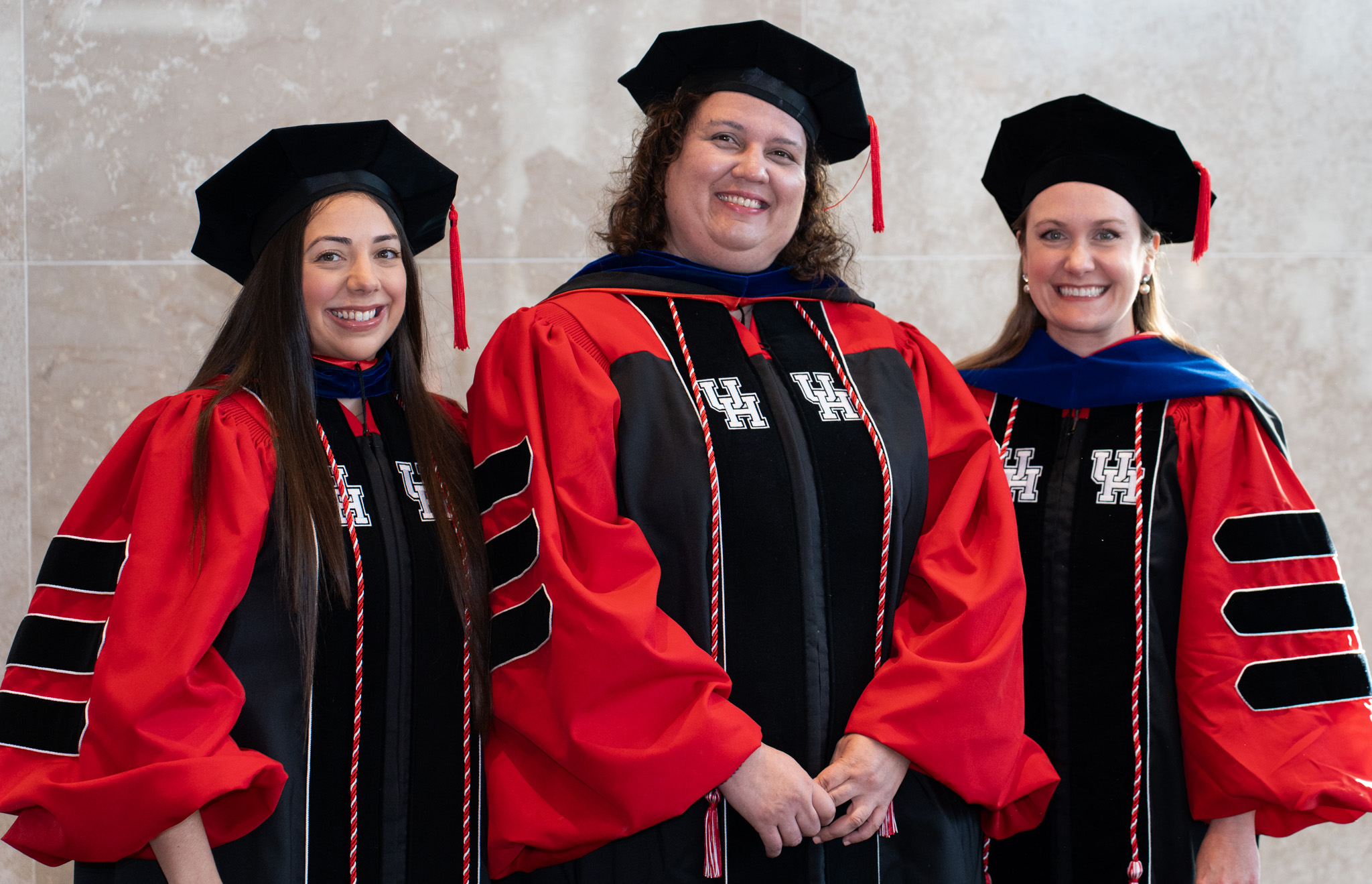
This month, Dueppen joined Michelle Hernandez and Janelle Flores as the first three
graduates of the University of Houston’s Ph.D. program in Communication Sciences and
Disorders, a milestone years in the making and one that marks a turning point for
UH, for Houston and for the future of speech-language pathology.
The idea of a doctoral program in speech-language pathology began more than a decade ago. Conversations were followed by years of proposals, reviews and approvals at UH and state levels. In 2019, the program was officially approved; in fall 2020, it welcomed its first cohort virtually due to the COVID pandemic.
The timing may have been unusual, but the need was clear.
Houston, home to the Texas Medical Center and one of the nation’s most diverse metropolitan areas, had no Ph.D. program in speech-language pathology, a surprising gap in the country’s fourth-largest city. The local need mirrored a national shortage of doctoral-level specialists in the field.
“Nationwide, we have 299 accredited master’s programs in speech pathology and over 30 awaiting accreditation but relatively few Ph.D.-trained specialists to teach those programs or lead the clinical research that moves the field forward,” said Ferenc Bunta, Ph.D., professor and doctorate program founding director.
Dr. Bunta and fellow faculty members designed the program around mentorship. Applicants identify instructors whose research aligns with their interests, and that relationship anchors the student experience from first semester through dissertation defense.
“Students have that person every step of the way,” said Margaret Blake, Ph.D., professor
and former department chair, who helped shepherd the program through final approval.
“It’s about finding the right fit—what the mentor can offer and what the students
want to learn from that mentor, because they will be working closely together for
several years.”
The three graduate candidates arrived at UH by vastly different routes, but what united
them was curiosity and the drive to answer questions the field overlooked.
Dueppen spent years as a professional opera singer before discovering a niche at the intersection of her two worlds: the rehabilitation of performing artists with voice disorders. No one was treating opera singers with an insider’s understanding of the fach system, the classification that determines a singer’s voice type and roles.
“There wasn’t anyone in this field that I knew who had experience in all the nooks and crannies when it comes to performing arts life, especially opera, that could also help rehabilitate,” she said.
After earning a master’s degree at the Moores School of Music, Dueppen chose Ashwini Joshi, Ph.D., UH’s Ph.D. program director, interim department chair and an associate professor specializing in voice disorder rehabilitation, as her doctoral mentor.
Her dissertation focused on pre-and post-operative care protocols for patients with
benign vocal fold lesions.
She is continuing her career at Lamar University, where she is an assistant professor,
and has already established a voice clinic and is building research partnerships with
Houston Methodist’s Center for Performing Arts Medicine.
Michelle Hernandez grew up bilingual in a Dominican household. She studied psychology
at Stony Brook University, then earned a master’s at SUNY Buffalo State. There, a
mentor encouraged her to explore doctoral work and connect with an advisor at UH.
In early 2018, Hernandez moved to Houston for a clinical fellowship in speech pathology, volunteering in UH labs on her days off and waiting for a program that did not yet exist.
“I moved here with the hope that UH would start the program,” she said. “When it launched in 2020, I applied immediately.”
Her research stems directly from family experience, watching how her siblings developed Spanish differently depending on usage and environment.
“I knew I wanted to work with families like mine,” she said. “Once I found speech pathology, I wanted to understand bilingual language development.”
Hernandez became the first student in the department to receive an NIH F-31 pre-doctoral diversity fellowship, funding her dissertation on code-switching patterns in bilingual children with and without developmental language disorders.
“I studied how children shifted between English and Spanish depending on the language of their communication partner and what those shifts might reveal about underlying language development,” she explained.
This fall, Hernandez joins the University of Nebraska-Lincoln as an assistant professor.
For Janelle Beth Flores, the road to UH included a detour.
A San Antonio native with two bachelor’s degrees and a master’s, Flores began her doctoral study at the University of Arizona. When her faculty mentor moved away, she transferred to UH in fall 2022.
Her research focuses on how bilingual educators and speech-language pathologists navigate referrals for bilingual children who may need language services, a process she identified as inequitable and understudied.
“There’s a disproportionate representation of bilingual children in speech and language services,” she said. “Some children who need services don’t receive them, while others may be referred unnecessarily.”
To her knowledge, no prior study had examined both educators and clinicians together
across the referral process.
“I wanted to look at the whole system and how we can make it more equitable for children.”
Flores has accepted a tenure-track faculty position at UT Health San Antonio, following in the footsteps of her mother, a retired University of Texas at San Antonio associate dean and bicultural-bilingual education faculty who encouraged Janelle to enter the field of speech-language pathology.
The significance of this first graduating class goes beyond the commencement ceremony.
“All three graduates secured faculty positions, and this was the outcome we dreamed
about for our students,” Bunta said.
The department now plans to submit a proposal for an NIH training grant that would fund future doctoral students. Enrollment has grown to 12 students, and the first part-time doctoral students have enrolled this year, expanding access for working professionals pursuing advanced study.