
It has been more than two decades since the seeds for Undergraduate Research Day were planted. Fast forward to 2026, and the event has blossomed into a cornerstone of student success at the University of Houston.
This year's Undergraduate Research Day continued the University’s tradition of showcasing hundreds of student projects throughout the MD Anderson Library. Students stood next to their respective research posters, ready to share insights on their faculty-mentored projects.
“One of the largest academic gatherings of undergraduate students on campus, URD offers something for everyone,” said Rikki Bettinger, director of UH’s Office of Undergraduate Research and Major Awards (OURMA). “It is a tried-and-true annual opportunity for faculty mentors to provide their students with an accessible venue to share their research.”
A majority of URD projects originated in OURMA programs such as the Summer Undergraduate Research Fellowship, Energy Scholars, Mellon Research Scholars, and the Provost’s Undergraduate Research Scholarship. These initiatives provide students with funding and guidance to investigate relevant global issues, sharpen their technical skills, and partner with faculty mentors.
This year’s undergraduate researchers included Cherise Johnson, a senior strategic communications major at UH’s Jack J. Valenti School of Communication. Johnson showcased her project, “Jukebox Killed the Barrelhouse Star: Technology, Barrelhouse Blues, and the Future of Music.”
Johnson’s research explored how the advent of automated musical technology was a death knell for the once-robust, piano-driven rhythm and blues that occupied Gulf Coast saloons. She was mentored by UH Libraries’ University Archivist Mary Manning.
“I’m passionate about music and technology,” Johnson said. “I wanted to bring this
topic to people’s attention because many artists are concerned how streaming and AI
technologies will affect their careers.”
Johnson noted that working with a mentor helped her learn more about the research
process and deepened her attachment to the subject matter.
“Mary has been great,” Johnson said. “She is very passionate about music, like I am! I was able to go through the University archives, learn how to analyze data, and put it into a spreadsheet. She was very helpful throughout the process, and we’re hopeful future students can continue this research after I graduate.”
Manning was on hand to applaud Johnson’s efforts, as were many other mentors, including architecture professor Donna Kacmar. Kacmar retired this spring after an illustrious career at UH’s Gerald D. Hines College of Architecture and Design; still, she was determined to attend her final URD to support mentee Sanam Davariar.

Davariar’s poster, “How Much of Los Angeles Is Physically, Economically, and Culturally Defined by Hollywood?” was developed in close collaboration with Kacmar. Davariar is grateful for the guidance and the opportunity to work alongside an architectural thought leader like Kacmar.
“It was a long process and very rewarding to learn so much,” Davariar said. “Professor
Kacmar is one of the best professors I’ve ever had. She was so gracious in helping
me narrow down my research and tie everything together.”
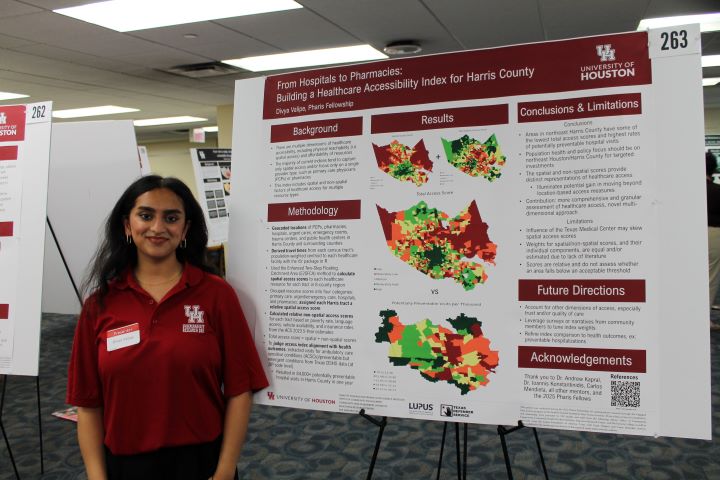
Divya Valipe was stationed just a few feet away from Davariar and Johnson. Her poster,
“From Hospitals to Pharmacies: Building a Healthcare Accessibility Index for Harris
County,” was inspired by a news article about the healthcare disparities faced by
Houston’s Settegast community. It prompted her to take a deeper dive into exploring
healthcare access within Harris County. She was mentored by Honors College faculty
member Andrew Kapral.
Valipe is presently a Harris Fellow and is double-majoring in mathematics and public policy. The experience of participating in this kind of project has been enlightening, to say the least. She hopes to have her research published and is grateful for the opportunity to have gone through the rigors of independent research while collecting data for her poster.
“One of the things I experienced while working on this project was how to learn from and deal with failure,” Valipe said. “There were times that I ran into a brick wall, but I had to leverage my faculty mentor and my own critical thinking. I was able to really think through this whole project, execute it, and address any adversities in the process.”
Valipe, Davariar, and Johnson are just three of the students acquiring new skills and cultivating essential expertise through their participation in Undergraduate Research Day. With the 2026 event in the history books, a new generation of students will soon begin preparing for next year. Until then, students and event organizers remain invigorated and inspired by the success of this year’s showcase. Bettinger, in particular, is proud of the breadth of scholarship displayed.
"From seeing first-time presenters gaining confidence, to the proud mentors and families, to the undergraduate wandering wide-eyed and exploring the innovative research happening right here at UH, it is hard not to leave inspired,” Bettinger said. “I’m so honored to play a part in it.”
Back to the May 2026 edition of Academic Update.