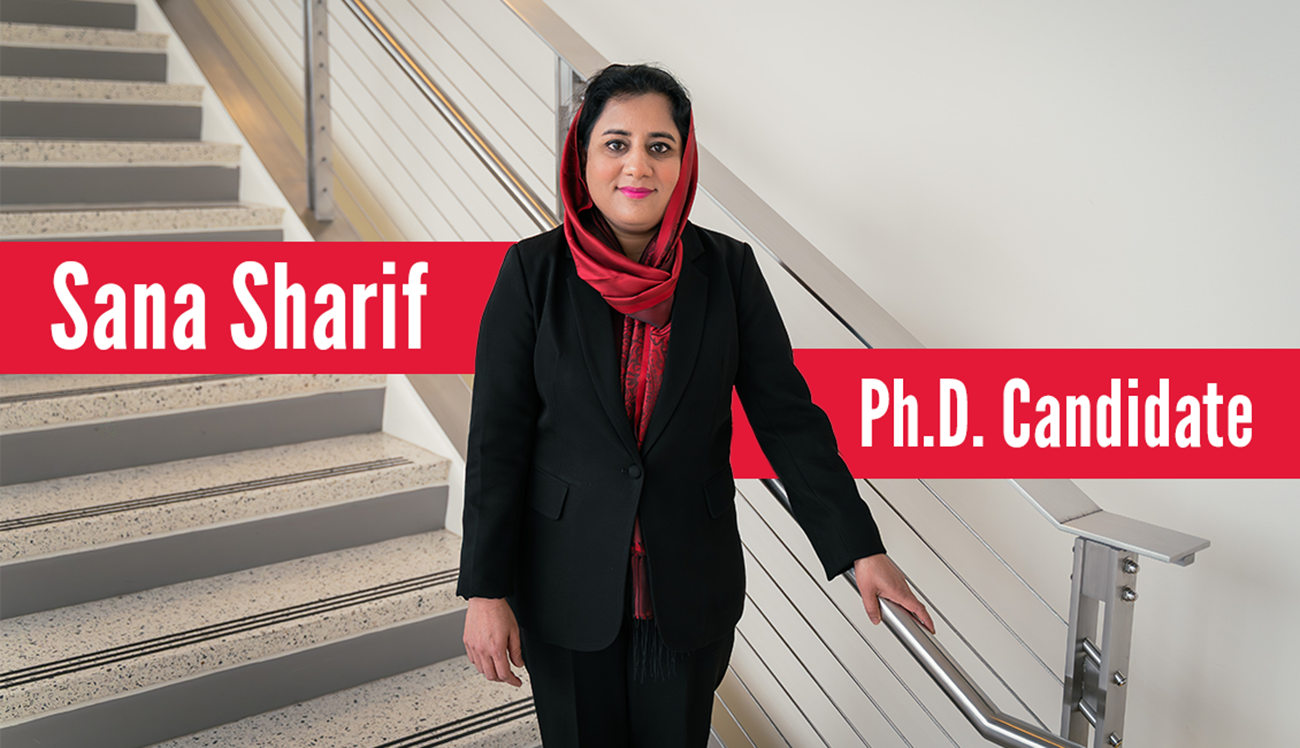
A small research project undertaken during the final year of Sana Sharif’s Doctor of Pharmacy degree program in her native Pakistan would change her career aspirations in a big way.
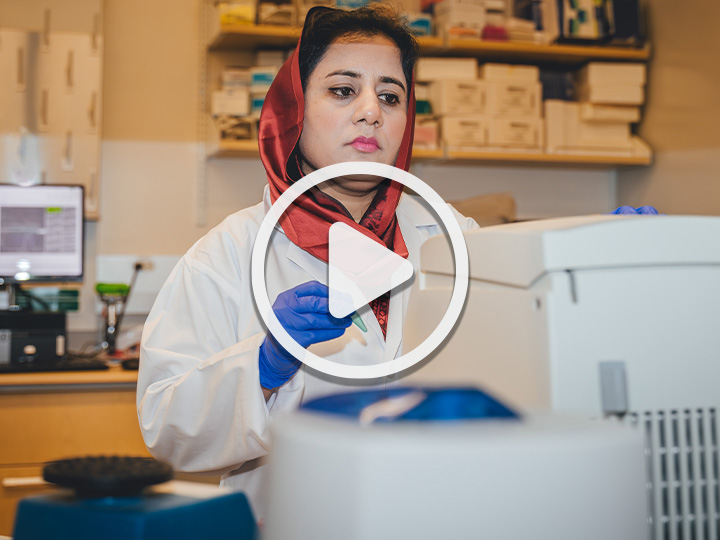 The project, investigating the socio-demographic factors contributing to tuberculosis,
was her first significant exposure to data analysis and scientific writing and sparked
her passion for research.
The project, investigating the socio-demographic factors contributing to tuberculosis,
was her first significant exposure to data analysis and scientific writing and sparked
her passion for research.
After completing her Pharm.D. degree, Sharif worked as a hospital pharmacist, where she witnessed patients' struggle with severe drug side effects. Seeing these challenges firsthand motivated her to begin her journey into developing safer, more effective drug formulations.
Upon completing a research-focused post-doctoral master’s degree, Sharif knew she wanted to study abroad to further her career aspirations. Through the US-PAK Knowledge Corridor Scholarship supported by the Pakistan Higher Education Commission, Sharif was accepted at the University of Houston College of Pharmacy (UHCOP).
“The college has strong research resources, well-equipped labs and advanced training opportunities,” Sharif said. “After spending so many years here, I can say it has been a very good fit for my doctoral training.”
Sharif has been working under Xinli Liu, Ph.D., associate professor of pharmaceutics, researching drugs for breast cancer treatment. While the drugs she is investigating already exist, they come with harmful side effects causing doctors to reduce or discontinue the treatment.
“We are exploring ways to improve tolerance and reduce side effects while improving therapeutic effectiveness,” Sharif said.
She is working on two types of nano-formulations for drug delivery: a synthetic lipid-based formula and a plant-derived exosome formula. The lipid-based formulations improve treatment delivery since many of the drugs she works with are hydrophobic. The plant exosomes – which are bubble-like transporter particles that can carry an array of cargo, from proteins to genetic material – are extracted from soybean plants which have shown to be effective in breast cancer treatment.
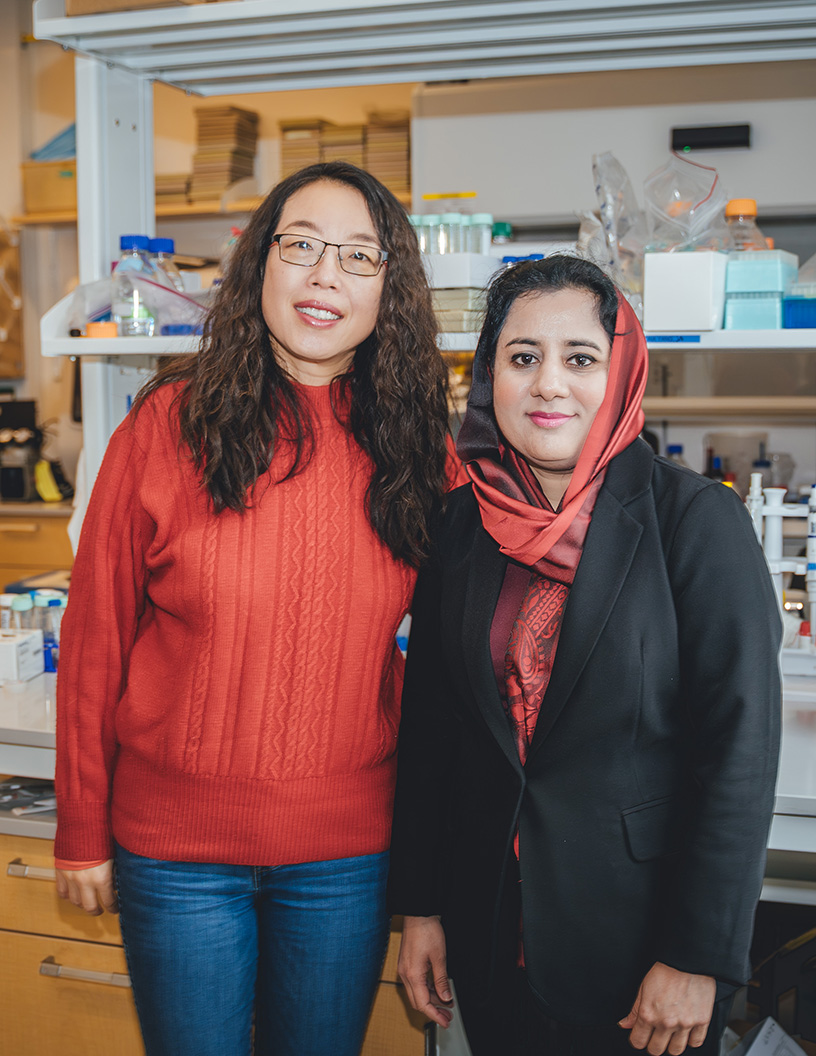
“We develop a murine cancer model and evaluate how effectively the formulation reduces tumors with minimum toxicity compared to conventional chemotherapy,” Sharif said.
They load the drugs into nano-sized particles, and once incorporated into nano‑formulations, the drugs become more stable. As they are released slowly into the biological system rather than all at once, toxicity is reduced.
Sharif said Liu’s mentorship has been a transformative experience for her, not only as a researcher but also as an individual with a healthy work-life balance.
“During my first three years, my husband and I were long-distance which was very hard,” Sharif said. “Dr. Liu gave me time to visit him, and that support meant a lot to me.”
Beyond the lab, Sharif is a reviewer in Journal of Clinical Pharmacology and Therapeutics and Journal of Pharmacometrics and System Pharmacology and an abstract reviewer for the American Association of Pharmaceutical Scientists.
After her expected graduation in June, Sharif said she hopes to continue her work in academia and one day lead her own research lab.
“During my Ph.D. I developed an interest in silicone modeling and model-informed drug development,” Sharif said. “This area falls under clinical pharmacology; a field I would like to pursue research in.”
Sharif plans to continue focusing on cancer research and pursue postdoctoral training after graduation.
“Cancer is very common,” Sharif said. “I chose to research breast cancer because it is the second most common cancer in women worldwide.”
Sharif is committed to advancing scientific discovery and contributing to solutions for real-world health challenges.
“If my formulation reduces tumors more effectively than the conventional one, with fewer side effects, then we can say it is better — and that is the ultimate goal,” Sharif said.