Students from a variety of majors are devoting their summers to serious research at
the University of Houston (UH), seeking eventual solutions to many serious maladies
that include Alzheimer’s, high blood pressure and cholesterol, diabetes, alcoholism
and anxiety.
With a record number of 54 participants this year, the Summer Undergraduate Research
Fellowship (SURF) program is open to UH undergraduates from all colleges and disciplines.
SURF provides students with a concentrated, 10-week research experience under the
mentorship of faculty members, with each student receiving a $3,500 stipend.
“The better we understand ourselves, our world and our universe, the more we can use
our knowledge to solve seemingly insurmountable problems,” said Casey Berridge, a
biology junior working with pharmacology professor Jason Eriksen. “I’m looking at
individual brain cells afflicted with Alzheimer’s that are not functioning properly
to see if they have an altered shape that could be causing these problems. This study
provides a direct look at how Alzheimer’s disease can affect the physiology of individual
neurons. In time, along with other studies, we hope to provide more and better options
of treatment for people with this debilitating disease.”
Working in Eriksen’s lab for some time now, Berridge said this project came about
as a result of prior collaborations with professor Jokubas Ziburkus’ lab in the biology
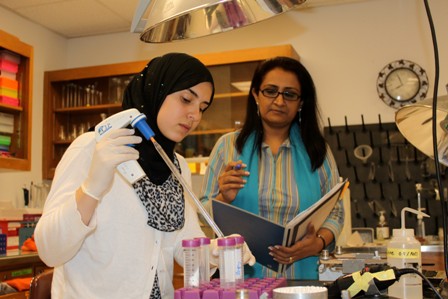
and biochemistry department. Ziburkus also is mentoring a SURF student, Ahmad Aulakh,
who will be starting his senior year in the fall with a major in mathematical biology.
Aulakh’s research concentrates on a particular protein mutation that causes plaque
in the hippocampus, which is the part of the brain essential for memory formation
and retrieval, and subsequently vulnerable to neurodegenerative diseases such as Alzheimer’s.
“Undergraduate research in the field of neuroscience is a unique experience that cannot
be demonstrated in any class,” Aulakh said. “The experience required me to use the
theory learned in class and apply it in practice. Not only did I learn new research
techniques, but I also learned details regarding the nervous system that are not taught
in class. Being in the lab has also exposed me to the vocabulary used in published
papers, which will help me understand subjects better as I move toward higher education.”
In studying oxidative stress and how it may cause disorders such as anxiety, hypertension
and type 2 diabetes, senior nutrition major Farida Allam echoes this sentiment, saying
that “the opportunity to finally apply book knowledge to actual models is not only
amazing to experience, but also really helps put everything into perspective.” Working
under the guidance of professor Samina Salim in the department of pharmacological
and pharmaceutical sciences, Allam says, “I believe this research can be beneficial
to everyone – young and old – helping the public understand the mechanisms of these
disease progressions. If we are well informed about oxidative stress, we are able
to take greater preventative steps toward a healthier population.”
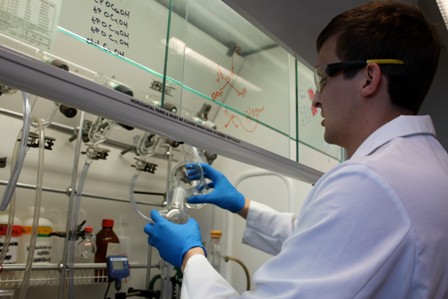
Another interesting project by a senior biology major is one that could eventually
lead to a drug that prevents cholesterol from clumping and clogging an artery. Thomas
Frank, who also is a chemistry minor studying under professor T. Randall Lee, is exploring
self-assembled monolayers. He is researching why carbon chains pack more densely together
when cholesterol is present. His work requires him to synthesize molecules with more
than five reactions until they are complete, so he must concentrate intensely to prevent
mistakes that could cost him as much as a week of lost time. This work also may eventually
lead to developing coatings for metals to prevent corrosion.
Also worthy of note is a project coming out of the biology and biochemistry department
that involves examining how the level of a particular protein in neuron communication
alters the responses of the fruit fly (Drosophila melanogaster) to alcohol. Working
with professor Gregg Roman, biology senior Vrutant Shah has undertaken the challenging
work of using molecular and behavior genetics to dissect the role of a specific protein
in producing the preference for alcohol-containing drinks.
“In previous work by Joydip Das in the College of Pharmacy, it has been demonstrated
that the unc13 protein can bind alcohol and may be a direct target for the effects
of alcohol in the nervous system,” Shah said. “Interestingly, similar to people, Drosophilae
like to drink alcohol because it makes them feel good. Our work will allow us to better
understand if alcohol binding to the unc13 protein is responsible for the effects
of alcohol within the nervous system.”
In addition to these students from the College of Natural Sciences and Mathematics
and College of Pharmacy, a student from the Conrad N. Hilton College of Hotel and
Restaurant Management (HRM) hopes her research will one day lead to standardized cleaning
methods for hotels. Under the guidance of Jay Neal, her faculty mentor, HRM senior
Katie Kirsch is doing research to find the areas that are most prone to contamination
in hotel rooms. For more on this story, visit http://app1.kuhf.org/articles/1310760031-UH-Moment-SURF.html.
At the end of the program, the SURF students will be prepared to present research
posters on their substantive projects at UH’s annual Undergraduate Research Day Oct.
13. For more information, visit http://uh.edu/honors/undergraduate-research/uh-research/urday2011/index.php.
###
Editorial Note: Photos of various SURF participants are available to media by contacting
Lisa Merkl.
About the University of Houston
The University of Houston is a Carnegie-designated Tier One public research university
recognized by The Princeton Review as one of the nation’s best colleges for undergraduate
education. UH serves the globally competitive Houston and Gulf Coast Region by providing
world-class faculty, experiential learning and strategic industry partnerships. Located
in the nation’s fourth-largest city, UH serves more than 38,500 students in the most
ethnically and culturally diverse region in the country.
For more information about UH, visit the university’s Newsroom.
To receive UH science news via e-mail, sign up for UH-SciNews.
For additional news alerts about UH, follow us on Facebook and Twitter.