TIEEP Podcast Archive
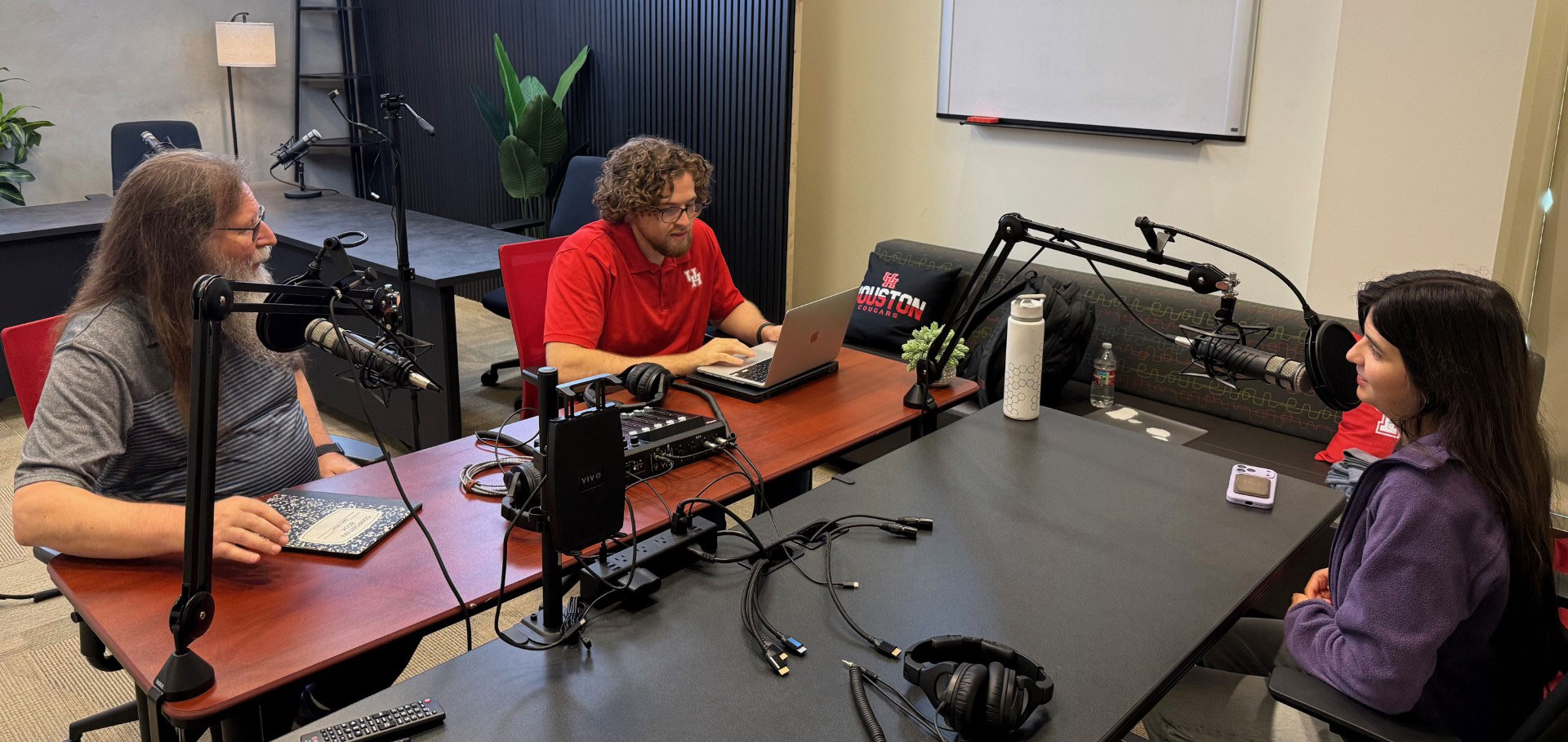
Learn more about the University of Houston’s outreach program and various events on energy and water management for Texas industries. This podcast is our newest endeavor to meaningfully engage with engineers, managers, and consultants working across the process industries.
The podcast is produced by UH Energy at the UH Media Lab with the support of the State Energy Conservation Office (SECO) in Austin, Texas. Every fortnight we look ahead to interesting industrial energy events in Houston or online, talk about interesting articles we have read and talks we’ve heard, and feature a new article on industrial energy efficiency. This is your biweekly 15-minute update on all things industrial energy.
The podcast is hosted by Dr. Gary Gildert, with interns Carla Romero, Hisham Habli, Christian Garcia, Shahriar Hossain, Kate Lambert, Makayla Hall and Sam Chimvai.
Episode 23: August 27, 2026
We Discuss Propane Dehydrogenation Again
Our guest on this episode of the podcast is Umair Surani from Environ Energy. We talk
about power bills in Texas.
This was a wide-ranging discussion that started with the basic structure of the electric
power industry in Texas. The unique “energy only” pricing concept in has a couple
of significant adders. We talk about the impact of this cost structure and how it
can affect energy efficiency projects. To be continued.
Episode 22: August 13, 2026
Interview with Umair Surani
Our guest on this episode of the podcast is Umair Surani from Environ Energy. We talk
about power bills in Texas.
This was a wide-ranging discussion that started with the basic structure of the electric
power industry in Texas. The unique “energy only” pricing concept in has a couple
of significant adders. We talk about the impact of this cost structure and how it
can affect energy efficiency projects. To be continued.
Episode 21: July 16, 2026
We Discuss Propane Dehydrogenation
Upcoming events:
- Webinar: Mechanical Vapor Recompression in Chemical Processes – Real-World Success Studies by Energy Group Webinars (July 21, 2026)
- Chevron Innovation Competition- Elimination Round (July 24, 2026)
- 2026 Steam System Masterclass Workshop (Aug 20-21, 2026)
- 2026 Southwest Process and Technology Conference (October 22-23, 2026)
Past Events:
- Home Energy Rebates. Please visit Inflation Reduction Act Opportunities for Feedback for more information
Shahriar and Gary discuss the article written by Shahriar about the energy efficiency of oxidative dehydrogenation of propane. This process has promise, but is it ready?
Episode 20: July 2, 2026
Interview with Jim Risko
Our guest on this episode of the podcast is James R. Risko, MBA, CEM, PEM, presenter, consultant, author, inventor. Jim is the retired president of TLV Corporation, Charlotte, NC, formerly responsible for US & Canadian operations. We talk about his forty-eight years of troubleshooting steam systems in all sizes of plants.
Jim is the instructor of the upcoming Risko Refinery & Chemical Plant Steam System Workshop at the Innovation Center, Technology Bridge at the University of Houston, 5000 Gulf Freeway, Houston, TX 77204. It takes place Thursday & Friday, August 20 - 21, 2025, 8:00am - 3:30pm. This course is suitable for engineers of all experience levels, plant operators, and maintenance managers seeking to deepen their practical understanding of steam and condensate systems and how they affect the serviced processes. It is particularly well‑suited for young professionals wanting to navigate the realm of complex and interconnected technologies in energy services.
Registration information here: Steam System Masterclass Workshop.
Episode 19: June 26, 2026
We Discuss Propane Dehydrogenation
Upcoming events:
- Chevron Innovation Competition- Elimination Round (July 24, 2026)
- 2026 Steam System Masterclass Workshop (Aug 20-21, 2026)
- STS-AIChE Southwest Process Technology Conference (October 22-23, 2026)
Past Events:
- Industrial Energy Technology Conference (May 19-21, 2026)
- Energy in Action Seminar, Digital Twins (May 29, 2026)
Shahriar and Gary discuss the article written by Shahriar about the energy efficiency of propane dehydrogenation processes. A semi-quantitative analysis is presented despite a lack of accurate process information.
Episode 18: June 12, 2026
Interview with Prof. Lars Grabow
Our guest on this episode of the podcast is Dr. Lars Grabow, professor of Chemical & Biomolecular Engineering here at the University of Houston. His research focuses on computational catalysis through which he gains tremendous understanding of various reaction systems and how catalytic reactions fundamentally work.
Computational catalysis is being used to discover new catalyst formulations. Improved catalysts leads to improved energy efficiency by increasing activity, improving selectivity and increasing catalyst life. Dr. Grabow talks about how a fundamental approach is used to find new alloys and reaction pathways faster than traditional experimental methods. He also talks about a non-steady-state operation that also increases catalyst activity, selectivity and life.
Episode 17: May 29, 2026
Upcoming Events:
- Energy in Action Seminar, Digital Twins (May 29, 2029)
- Steam Workshop (to be determined)
- 2026 SPTC (October 22-23, 2026)
Past Events:
- CCUS Technical Forum (April 29, 2026)
- Southwest Catalysis Society Annual Meeting (May 1, 2026)
- Commencement (May 14, 2026)
- Industrial Energy Technology Conference (May 19-21, 2026)
The CCUS Technical Forum generated a lot of discussion amongst the attendees. Some of that is captured here.
Episode 16: April 23, 2026
Upcoming Events:
- Industrial Energy Technology Conference (May 19-21, 2026)
- Energy in Action Seminar, Digital Twins (May 29, 2029)
Past Events:
- Coogs for Energy Hackathon (April 10-11, 2026)
- 2026 AIChE Spring Meeting and 22nd Global Congress on Process Safety (April 12-16, 2026)
Carla and Gary discuss the article written by Carla about the energy efficiency of geothermal power generation. What is old is new again. Energy efficiency is a difficult metric to describe geothermal, but the low levelized cost of production makes this an exciting evolving technology.
Episode 15: March 26, 2026
Upcoming events:
- Coogs for Energy Hackathon (April 10-11, 2026)
- 2026 AIChE Spring Meeting and 22nd Global Congress on Process Safety (April 12-16, 2026)
- Industrial Energy Technology Conference (May 19-21, 2026)
Past Events:
- Energy in Action Seminars - Artificial Intelligence in Energy Processes (February 27, 2026)
- TIEEP Pinch Analysis Workshop, and Water Forum (March 5-6, 2026)
- Energy Transition Webinar Series (March 10, 2026)
Carla and Gary discuss their experience and the presentations at the pinch analysis workshop and the water forum. Following this, Hisham and Gary discuss the article written by Hisham about the energy efficiency of plastic recycling methods. Landfilling, incineration, mechanical recycling, and the more novel chemical and thermal decomposition recycling methods are summarized with their economic and energy efficiency metrics.
Episode 14: March 19, 2026
Interview with Todd McAllister
Gary talks with Todd McAllister, CEO of SPEER (South Central Partnership for Energy Efficiency as a Resource), about energy efficiency across Texas and Oklahoma. Todd explains what SPEER is and how it works through training contractors, engaging with the PUC, and partnering with local governments and universities. Todd and Gary also talk about heat pumps vs. resistance heating, why demand response hasn’t fully taken off, and how the real challenge is getting landlords, utilities, and customers on the same page in regards to incentives. Tune in this week to hear their practical look at how small changes could add up to big impacts on the grid.
Episode 13: February 26, 2026
Upcoming events:
- Energy in Action Seminars - Artificial Intelligence in Energy Processes (February 27, 2026)
- TIEEP Pinch Analysis Workshop, and Water Forum (March 5-6, 2026)
- Energy Transition Webinar Series (March 10, 2026)
Past Events:
- Energy in Action Seminars - AI and the Net-Zero Journey with Shell (February 13, 2026)
- Energy Transition Institute Seminars - PACE Financing: A Scalable Tool for Energy and Water Efficiency, Resilience, and Economic Development February 10, 2026)
Gary and Carla discuss whether AI-powered energy systems can be trusted to manage industrial processes. Gary recounts his own plant operations experience to urge some caution, suggesting that it is better to use AI as a pattern recognition tool than giving it full control of a process. Next, Hisham previews his research into advanced plastic recycling, taking a closer look at the range of thermal and chemical decomposition methods and how they compare in terms of energy efficiency. Keep an eye out for his full write-up in the March newsletter.
Episode 12: February 17, 2026
Interview with Dub Taylor
Gary talks about PACE (Property Assessed Clean Energy) with Dub Taylor, the CEO of Texas PACE Authority. PACE is a financing program that's helping property owners finally move forward on energy and water efficiency projects for which traditional bank loans just don't work well. Dub walks Gary through how the program works, who it's for, and why the private capital behind it means no public dollars and no budget cycles, and how there’s a lot more flexibility. He also gets into some of the more surprising applications showing up on PACE's radar lately, including the infrastructure powering the data center boom here in Texas.
Episode 11: February 12, 2026
Interview with Margaret Cook
Gary is joined by Margaret Cook of HARC (the Houston Advanced Research Center) to discuss her article "Thirsty Data and the Lone Star State." This article examines the impact of data center growth on Texas water supply. Margaret explains that while much attention focuses on the massive power demands of data centers, water consumption is an equally critical concern. Cooling systems, particularly water-based heat rejection technologies, consume enormous amounts of water through evaporation, which, in other words, is water that never returns to the local watershed. With new facilities reaching hundreds of megawatts, the scale of that consumption is staggering. Margaret highlighted a troublingly large planning gap: data centers don't provide water usage forecasts, so they aren't actually being factored into Texas's state water plan. This means that communities may unknowingly be giving away water intended for future residents. Some of her recommendations to fix this include greater industry transparency, public–private partnerships for water infrastructure investment, alternative water supplies like brackish water desalination, and offsetting water use within the same watershed to achieve net zero or even net negative water impact.
Episode 10: January 30, 2026
Interview with Dr. Alan Rossiter
Gary sits down with Dr. Alan Rossiter, retired Executive Director at UH Energy, to discuss pinch analysis. Pinch analysis is a methodology for optimizing heat recovery in industrial chemical processes. Rather than relying entirely on external utilities like steam or cooling water, this analysis identifies how much heating and cooling can be handled through internal process heat exchange. Don't miss Dr. Rossiter's upcoming workshop on pinch analysis at the University of Houston Technology Bridge on March 5th!
Episode 9: January 15, 2026
Upcoming events:
- Energy in Action Seminars - AI and the Net-Zero Journey with Shell (February 13, 2026)
- Energy in Action Seminars - Artificial Intelligence in Energy Processes (February 27, 2026)
- Energy Transition Webinar Series (February 10, 2026)
Past Events:
- Energy Transition Webinar Series (January 27, 2026)
Gary talks with interns Hisham and Carla to recap a visit to the Houston Advanced Research Center (HARC) in The Woodlands, a "Living Lab" net zero building that tracks energy usage down to individual appliances and earned a 99/100 EPA Energy Star rating for seven consecutive years. Gary and Carla then dive into the second half of the hydrogen production article, this time focusing on electrolyzers instead of fossil fuels. Carla walks through the same two metrics used previously, which are first law energy efficiency and capital expenditure, applied to three electrolyzer types: alkaline, proton exchange membrane (PEM), and anion exchange membrane (AEM). Surprising to them, all three operate at similar efficiency, but differ in cost, durability, and compatibility with renewable energy sources.
Episode 8: January 15, 2026
Upcoming events:
- Energy in Action Seminars - AI and the Net-Zero Journey with Shell (February 13, 2026)
- Energy in Action Seminars - Artificial Intelligence in Energy Processes (February 27, 2026)
- Energy Transition Webinar Series (January 27, 2026 and February 10, 2026)
Past Events:
- None, Happy Holidays!
Building from Episode 3 on October 30,2025, Gary and Hisham discuss an article Hisham and Carla wrote covering the energy conversion efficiency of hydrogen production from fossil fuels and their associated capital costs. Steam methane reforming, coal gasification and methane pyrolysis were assessed on those two metrics and they discussed whether these were good metrics to use when comparing these processes.
Episode 7: January 9, 2026
Interview
Our guest on the podcast is Dr. Michael Harold, professor of Chemical & Biomolecular Engineering here at the University of Houston. His research focuses on catalytic reaction engineering where he gains tremendous understanding of various reaction systems and how catalytic reactions fundamentally work.
Gary and Mike discuss the challenges, opportunities and energy efficiency associated with electrified steam methane reforming. His research focused on coiled wire heating, like that of a toaster oven, to provide the energy for heat electrically as opposed to providing energy by burning fuels. By using this method, many benefits such as energy efficiency and conversion improved, which is promising research for the future of steam methane reforming.
Epsiode 6: December 18, 2025
Upcoming events:
- Energy Transition Webinar Series (TBD)
- Energy in Action Seminar Series (Jan 26, 2026)
Past Events:
- Reuters Events: Energy LIVE (Dec 9–10, 2025)
- Energy in Action Seminar Series Beyond the Hype: Amplifying AI Impacts in Fuel and Petrochemical Industry (Dec 9, 2025)
- Energy Transition Webinar Series Unlocking Nature's Power for a Healthier, Safer, More Resilient Houston (Dec 2, 2025)
- Coogs for Energy Hackathon (Nov 21–-22, 2025)
- Energy In Action Seminar Series Google Cloud Talk: AI, Energy, and Data Centers (Nov 17, 2025)
Carla and Hisham speak with Gary about the article they wrote in December 2025 newsletter covering routes for Methanol Production and their Efficiencies. They discuss the traditional routes in comparison to the most novel route for producing the carbon monoxide needed as feedstock: CO2 reduction. This talk covers the basics of each process and the efficiency associated with each process that Carla and Hisham calculated.
Episode 5: November 20, 2025
Upcoming events:
- Coogs for Energy Hackathon at UH Student Center South (November 21–22, 2025)
- Energy Coalition Power Hour Social (December 4, 2025)
Past events:
- Energy in Action Seminar Series, “Beyond the Hype: Amplifying AI Impacts in Fuel and Petrochemical Industry” (November 17, 2025)
- Energy Transition Institute – Five energy efficiency related webinars this semester
- Texas Energy Summit (November 4–6, 2025)
Gary talks with Hisham about an article he wrote for the newsletter on the various pathways for hydrogen production and their energy efficiency. They talk about nine different colors denoting the different methods of producing hydrogen and compare their energy conversion efficiency. Hisham and Gary note that many novel methods lack consistent techno-economic and energy efficiency analysis. This requires further study for future articles and podcast episodes where we can compare costs, efficiency, and feasibility.
Episode 4: October 30, 2025
Upcoming events:
- Energy Coalition talk on Carbon Management Across Energy Sources (November 12, 2025)
- Energy in Action Seminar Series, “Beyond the Hype: Amplifying AI Impacts in Fuel and Petrochemical Industry” (November 17, 2025)
- Coogs for Energy Hackathon at UH Student Center South (November 21–22, 2025)
Past Events:
- Energy Day at Sam Houston Park (October 18, 2025)
- Future of Natural Gas Symposium at UH Student Center South (October 9, 2025) · SPE Annual Technical Conference (October 20–22, 2025)
Carla and Gary discuss the way in which many published studies emphasize technical performance but provide insufficient energy balances, cost breakdowns, and process integration assumptions, limiting their relevance to industrial deployment. Credible efficiency claims must include capex and opex estimates, realistic equipment lifetimes, scalability limits, and sensitivity analyses, and not solely rely on laboratory or simulation-based results.
Episode 3: October 23, 2025
Upcoming events:
- Coogs for Energy Hackathon at UH Student Center South (November 21–22, 2025)
- Energy Coalition talk on Carbon Management Across Energy Sources (November 12, 2025) · SPEER webinars (various dates)
Past events:
- Future of Natural Gas Symposium at UH Student Center South (October 9, 2025)
- 2025 Southwest Process Technology Conference (September 22–23, 2025) reviewing one of the two sessions on Industrial Energy Efficiency and the Water Conservation session.
Carla and Gary discuss a research article of how electrochemical methods showed promise over traditional high-temperature routes converting CO₂ into CO as a pathway to recycle carbon into fuels and chemicals. Catalyst durability and true efficiency still need to be validated at industrial scale.
Episode 2: Interview with Dr. Omar Abdelrahman
Interview
Dr. Omar Abdelrahman, professor of Chemical & Biomolecular Engineering here at the University of Houston, is our guest on the podcast. His research focuses on thermal catalysis, electrochemistry, and photochemistry for chemical transformations.
Gary and Omar discuss electrochemical reactions used can make complex reactions, like turning CO₂ into fuels, more efficient. They also discuss programmable catalysis. By rapidly changing the energy at the catalyst surface, researchers can speed up reactions and adjust selectivity without redesigning reactors.
Episode 1: October 03, 2025
Upcoming events:
- Future of Natural Gas Symposium at UH Student Center South (October 9, 2025)
- Energy Day at Sam Houston Park (October 18, 2025).
Past events:
- 2025 Southwest Process Technology Conference (September 22–23, 2025) reviewing one of the two sessions on Industrial Energy Efficiency.
Gary talks with Hisham about an article he wrote for the newsletter on the growth in AI and data-heavy workloads. This is driving a sharp increase in data center energy use, especially for cooling. They discussed single-phase and two-phase liquid cooling systems, where chemical engineering plays a key role in improving efficiency.