Energy Affordability
Energy affordability is the capacity of households to pay for their essential energy needs (electricity, natural gas, heating, fuel) without having to compromise other necessities like food, medicine, or rent. Infrastructure upgrades, the surge of AI and data centers, and extreme weather represent an increasing threat to household energy affordability. Key solutions for energy affordability have emerged, including local and federal assistance programs – such as LIHEAP (Low Income Home Energy Assistance Program) and WAP (Weatherization Assistance Program), rate caps – improved grid efficiency, and community projects (e.g., community solar farms, microgrids).
Understanding energy affordability and its role in the energy system remains increasingly essential, particularly for the State of Texas who leads the nation in oil and natural gas production and wind energy generation, while continuing to expand its clean energy capacity. Nonetheless, Texas' energy demand is rapidly increasing due to its rapid population increase, constant exposure to extreme weather events, grid disruptions, and rapid growth from data and AI infrastructure.
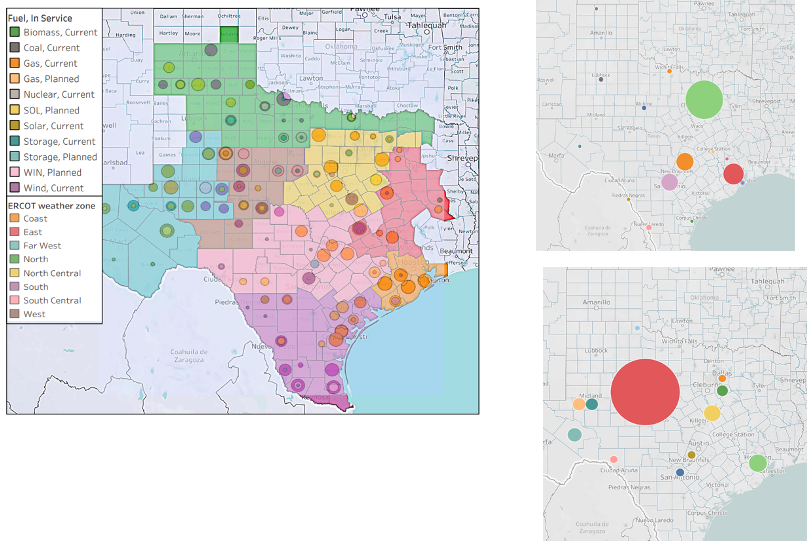
These changes are having an impact on how the costs of the energy transition are distributed across households and regions. A large portion of the state’s new power generation and transmission projects are being directed toward rapidly growing large load corridors, rather than toward regions with the highest energy burdens (Figure 1). Simultaneously, surveys and administrative data show that energy burden is not evenly distributed across regions or socio-demographic groups. Economically vulnerable regions, Black (24.4%), Hispanic (29.8%), and other non-white racial minorities (32.4%) are more likely to report difficulty paying their energy bills (Figure 2).
 |
 |
|
Figure 1 |
Left panel: Summer average monthly electric bill as a percentage of income by county, results from the Texas Trends Survey 2025 (N/A shows counties with no respondents due to sampling). Right panel: percentage of population living below poverty rate (data from the U.S. Census Bureau-American Community Survey, 2024). |
A team of researchers from the Hobby School and UH Energy is working to advance knowledge in Energy affordability. Results from ongoing Energy affordability related projects can be found in technical reports, working papers, blog entries and media listed below:
Technical reports:
Survey based research from Texas Trends and the SPACE city Panel by the Hobby School CPP main findings include:
|
|
|
|
Electric bills and spending: There is widespread concern over rising electricity costs and unequal energy burdens among Texas householders. The average monthly summer bill is $168. The report also explores Payment hardships, housing and home energy efficiency, energy use priorities, and clean-energy perceptions. |
Regardless of political views, respondents support efficiency-enhancing policies, such as improving industrial facilities and energy infrastructure, which curb carbon emissions without eliminating reliance on fossil fuels. Preferences of respondents who don’t identify with either major party identified align closer to those of Democrats. |
| Derecho and Hurricane Beryl – 2024 | Heat perceptions – Heat Wave 2023 |
 |
 |
| Many Texas households have experienced blackouts from numerous natural disasters in recent years, especially in the larger Houston metro area and coastal region, which were in the path of Hurricane Beryl. |
About three-quarters (75.8%) of Texans describe the summer of 2023 as hotter than previous summers, with only one-fifth (20.5%) saying it was about the same. The most common measure Texans took to reduce energy usage this summer was turning off the lights when not in use (74.9% of respondents). |


Working papers:
Watt’s the Price of Keeping the Lights On? Natural Disasters and Willingness to Pay for Reliable Electricity (Manuscript under review)
Community Energy, Energy Burden, and Affordability: Evidence from Houston. Results presented at the National Academies Understanding & Addressing Energy Affordability in the U.S. Workshop in February 2026. (Working paper)
Administrative Burden and Access to Energy Assistance Programs: Institutional and
Policy
Determinants of Energy Affordability in the U.S. Results presented at the National Academies Understanding & Addressing Energy Affordability
in the U.S. Workshop in February 2026. (Manuscript under review)
Blog entries - UH Energy Perspectives:
February 24, 2026: Winter Storm Uri, Five Years Later: Why Texans Who Suffered Most Now Trust the System Least.
November 18, 2025: Escalating electricity prices are deepening energy insecurity for millions of Texans.
August 19, 2025. The Electricity Costs We Don’t Talk About.
May 21, 2025. Eliminating Energy Assistance Programs Will Hurt the Poorest in Houston and Across the Southeast.
Research team working on Energy Affordability:
Hobby School:
Pablo Pinto, Distinguished professor and Director, Center for Public Policy
Gail Buttorff, Research Associate Professor and Associate Director, Center for Public Policy
Maria P Perez Aguelles, Research Assistant Professor
Agustin Vallejo, Research Assistant Professor
Soran Mohtadi, Post Doctoral Fellow
UH Energy:
Ramanan Krishnamoorti, VP, Energy & Innovation
Aparajita Datta, Energy Policy Associate