Active Project
Offshore Asset Integrity Monitoring: Environmental Monitoring
Subsea Systems InstituteThis project pioneers a self-powered sensor network that harvests energy from ocean waves to monitor offshore assets and detect environmental hazards in real time—offering a sustainable, resilient solution for deep-sea operations.
Project Objective
The primary objective of this project is to develop and deploy a network of self-powered, distributed sensors and reporters for real-time monitoring of offshore infrastructure and the marine environment. This includes:
- Designing and fabricating triboelectric-powered blinkers that harvest energy from ocean waves and currents to emit light signals and power integrated sensors.
- Implementing organic electrochemical transistor (OECT)-based sensors for early detection of hydrocarbon leaks and other chemical contaminants in subsea environments.
- Evaluating sensor performance under realistic marine conditions and enhancing detection capabilities using machine learning to optimize sensor chemistry.
Project Significance & Impact
This project delivers a transformative approach to offshore monitoring by integrating self-powered sensors that harvest energy from ocean motion and detect environmental threats in real time. It addresses critical challenges in remote asset management, offering a scalable, resilient solution that enhances safety, reduces environmental risks, and supports sustainable operations. Beyond oil and gas, the technology has broad applications in environmental monitoring, water treatment, and biomedical sensing—positioning it as a versatile innovation with global relevance.
Project Details
Background:
Development of Self-powered Distributed Sensors/Reporters for Integrated Offshore Asset and Local Environment Monitoring
Triboelectric effect has been known to human beings for thousands of years. It is responsible for the charging of clouds and subsequent lighting, as well as for the charged amber and fur after rubbing. However, only recently has the electricity from triboelectric effect been harvested and used to power external circuits. Immobile charges at two interfaces are transferred to external electrodes through static induction and relative motion of the interfaces, such devices are called triboelectric nanogenerators (TENGs).
Since the electricity is harvested from the environment, more electricity can be harvested by deploying more generators, and electricity can be conveniently collected with a capacitor, thus besides LEDs, triboelectric generators can power up more devices. In fact, many various sensors have been integrated with the generators to provide local information such as temperature, humidity, pressure, etc. This network of distributed generators and sensors forms an Internet of Things (IoT) for reliable and efficient monitoring and management. Compared to a typical environment, ocean waves and subsea currents can provide far more energy and thus are a perfect environment to generate distributed powers.
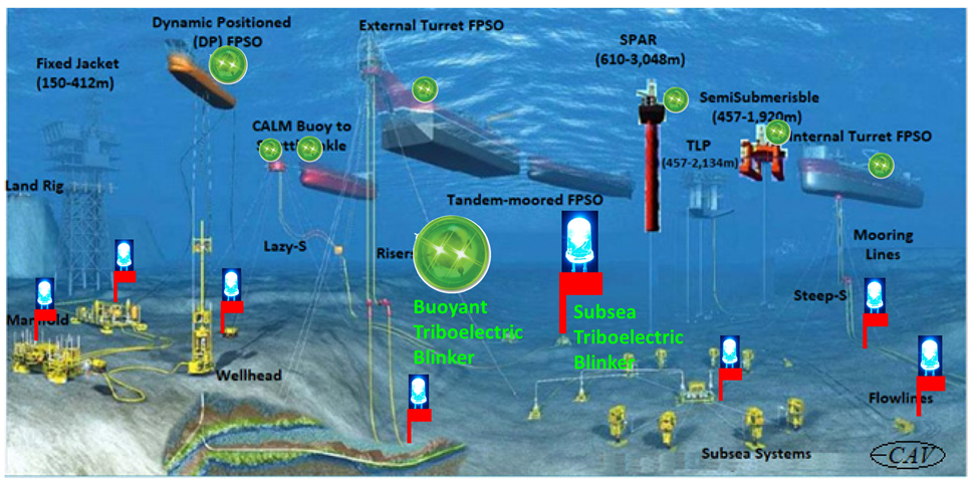
Fig. 1 below illustrates how these self-powered blinkers are deployed to monitor the asset in shallow and deep sea.
Practical Implementation of Organic Electrochemical Transistors (OECTs) for Subsea Detection
Pipeline leaks are costly, dangerous, and detrimental to the environment. While Supervisory Control And Data Acquisition (SCADA) systems can detect leaks, methods for earlier leak detection can help reduce the negative impacts of leaks and enable a faster response. In our previous work supported by the SSI, we demonstrated that sensors based on organic electrochemical transistors (OECTs) can potentially be used for rapid detection of hydrocarbons and petrochemical derivatives in the subsea environment. Specifically, we developed sensor devices that rapidly responded to various alcohols and organics in seawater. The sensors functioned successfully in both synthetic and real seawater (Galveston), displaying a characteristic transfer curve which represents a systematic modulation of the source-drain current.
Project Task and Goal Overview
Task 1: Development of self-powered distributed sensors/reporters for integrated offshore asset and local environment monitoring
| Goals | Completion Status |
| Design of highly efficient buoyant triboelectric blinkers | 95% complete |
| Fabrication and characterization of buoyant triboelectric blinkers | 95% complete |
| Test of buoyant triboelectric blinkers in the tank and Galveston Bay | 0% complete |
| Design of subsea triboelectric blinkers | 0% complete |
| New Technology Qualification (NTQ) and third-party verification | 0% complete |
Task 2: Practical Implementation of Organic Electrochemical Transistors (OECTs) for Subsea Detection
| Goals | Status |
|---|---|
| Evaluate the effect of subsea conditions on OECT performance | 100% complete |
| Improve the specificity and sensitivity of MIPs | 100% complete |
| Test a multiplexed array of sensors capable of operating simultaneously to either detect multiple, different contaminants and/or spatially localize the source of a leak | 80% complete |
| Quantify the lifetime and stability of OECTs in subsea conditions | 90% complete |
Gantt Chart:

Project Team


Dr. Haleh Ardebili
Kamel Salama Endowed Professor of Mechanical & Aerospace Engineering
Assistant Vice President of Entrepreneurship and Startup Ecosystem

Dr. Rafael Verduzco
Professor and Associate Chair, Chemical & Biomolecular Engineering
Professor, Materials Science & Nanoengineering