Offshore oil platforms are aging, and many are being considered for exciting new uses—from renewable energy hubs to rocket launch pads. But before that can happen, they need to be safe and reliable. This project is developing smart robots that can inspect hard-to-reach areas, detect rusted valves, and check for loose bolts—helping extend the life of these platforms while reducing the need for risky and expensive manual inspections.
Project Significance & Impact
Thousands of offshore platforms around the world are in poor condition due to years of wear and limited maintenance. This project offers a safer, faster, and more affordable way to inspect and maintain them using robotic systems. These robots can climb stairs, navigate tight spaces, and even “tap and listen” to detect hidden problems—just like a mechanic might knock on a pipe to check for damage.
By catching issues early, this technology helps prevent leaks, reduce repair costs, and make offshore platforms ready for new roles in clean energy and space exploration. It’s a smart step toward safer seas and a more sustainable future.
Project Outcomes
Project Details
Offshore drilling activities over the last decades have left thousands of offshore platforms in bad condition and abandoned because of impropriate maintenance and operation. This is in part due to the expense and time-consuming nature of manual inspection and maintenance in the remote offshore environment. Those offshore platforms will not only be re-used in renewable energy sector (thermal, offshore wind, and tidal), but also in space sector. For example, the offshore platform could be used by NASA or space tech companies for rocket launching and landing pads. Some reported news indicate that Space-X will reuse the existing offshore platforms as spaceports for its re-usable rockets.
Timely inspection and maintenance of the existing offshore platform is of great interest of Texas economy. To extend the lifetime of existing platforms, timely inspection and maintenance of platform infrastructures are of great importance. Among those critical components in offshore operations, 1) valves and 2) bolted connections are high priority to assess for failure.
One of the challenges in valve operation is the valve's failure caused by rust. Mild rust can cause the valve's rough operation. Excessive rust may lead to permanent structural damage and cause serious leakage. Preventing a valve's failure requires regular inspection and maintenance. As most of the platforms are designed with a limited area and multi-level structure (Fig. 1), an unmanned ground vehicle (UGV) should be capable of making a small radius turning and climb up/down stairs to qualify the job.
Tapping and listening, also called percussion, is an intuitive way to detect structural abnormality, which has been used by us to invent a new approach to monitoring the looseness of bolted connections.
Additional Media Assets:

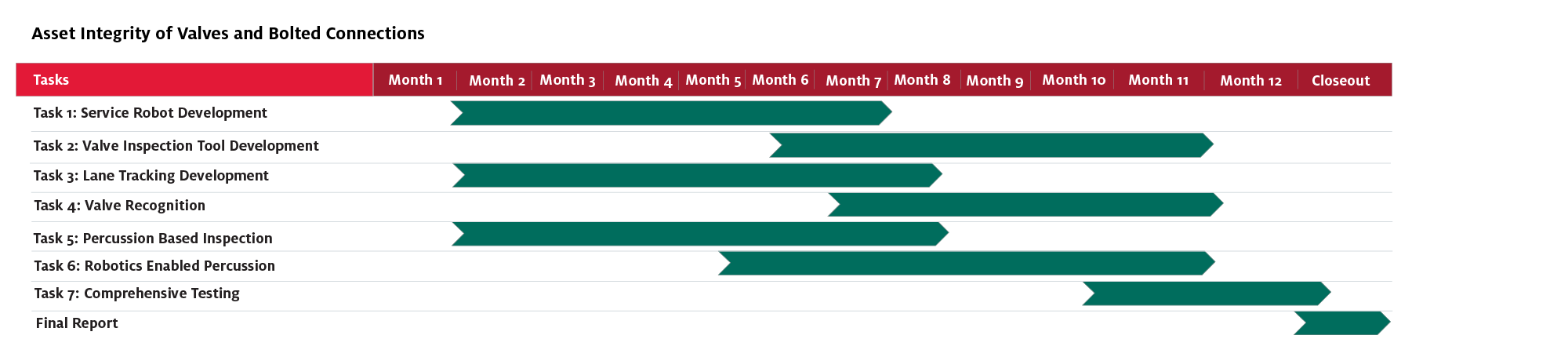
Gantt Chart: