Past News & Events
2023
Celebración del Año Escolar 2022-2023 Entrega de Premios Escritura Revuelta
19 de abril 2023
Graduate Student Spotlight
Our graduate student Iván Brave is the recipient of one of The Support for Artists
and Creative Individuals (SACI) grants this year.
Read More
Taller de desarrollo profesional para maestros de español
El Departamento de Estudios Hispánicos de UH y el Capítulo de la AATSP de Texas-Brazos co-auspician este programa.
2022
News Release: Gabriela Baeza Ventura Elected To Mla’s Digital Humanities Forum
Gabriela Baeza Ventura was elected to serve on the Modern Language Association (MLA) Transdisciplinary Connections Digital Humanities Forum Executive Committee for 2022-2027. As part of this forum, Baeza Ventura will help to represent areas of scholarly and professional interests for MLA members. Learn more
2021
Doctoral Student Receives Grant for Interdisciplinary Artistic Pursuits
Ph.D. Student in Spanish with a Concentration in Creative Writing/Arts Wins Artadia Award
Valentina Jager, Ph.D. student in Spanish with a Concentration in Creative Writing has won one of the Houston Artadia Award for visual artists who have been living and working within Harris County for a minimum of two years. According to their press release “Artadia provides social and financial support for visual artists to sustain a thriving practice and continue creating their vital work.” Executive Director Carolyn Ramo noted “artists play an essential role in shaping our communities, serving as social leaders and cultural innovators, and Artadia is honored to celebrate these individuals through our Award program.”
Congratulations Valentina!
Learn More:
https://preview.houstonchronicle.com/art-exhibits/cash-awards-keep-houston-s-struggling-artists-15865154
https://artadia.org/news/announcing-the-2020-houston-awardees/
2019
Doctoral Student Raquel Abend New Poetry Book
2018
Public lecture: “Minimal Computing, Border Technologies and Other Marginal Practices in the Digital Humanities”
Thursday, March 29
3:00pm-5:00pm
MD Anderson Library 266-C
University of Houston
No RSVP required.
*Light refreshments provided
*We will live-tweet the event using #usLdh and livestream the video on our Facebook
page
This talk will explore the epistemological edges of Digital Humanities to look at recent trends that open it up to diasporic and global south practices. Minimal computing embodies a form of thinking that is planetary and emancipatory in scope, connecting it to other forms of technological disobedience found in the global south. Gil will compare some of those edge cases—pirate libraries, immigrant tech use, repurposing, etc.—to the production mechanisms of private and public enterprises in the North Atlantic world. Learn more
Mary Louise White Scholarsips
Deadline: April 9, 2018
Download Flyer for more information
Public lecture: “Archives in the Anthropocene”
Arte Público Press/Recovering the US Hispanic Literary Heritage at the University of Houston invites you to a Digital Humanities & Social Justice lecture and workshop by:
Purdom Lindblad
Assistant Director of Innovation and Learning
Maryland Institute for Technology in the Humanities (MITH)
Thursday, February 15
2:00pm-5:00pm
MD Anderson Library 266-C
University of Houston
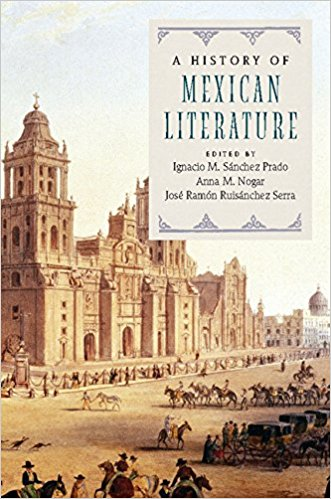
Dr. José Ramón Ruisánchez receives a Choice Academic Award
A History of Mexican Literature, co-edited by professor José Ramón Ruisánchez with Ignacio Sánchez Prado and Anna Nogar, received a "Choice Academic Award" as a distinguished scholar publication of 2017. It was also selected as one of the 75 books recommended for community college libraries.
Speaker series and workshops on Digital Humanities and Social Justice
Public Lecture: "A Carrier Bag Theory for Digital Humanites"
Thursday, January 25
3:00 p.m. - 5:00 p.m.
This Talk applies Donna Haraway's "carrier bag theory" to the Digital Humanities and considers how to transform digital archival work into social justice.
Workshop: Digital Cultural Heritage Collections with Omeka and Neatline
Friday, January 26
10:00 am - 12:00 pm
2017
¿POR QUÉ LO PINTAN DE DÍA?
Clase e identidad en el graffiti del Segundo Barrio
Date: Viernes 8 de Diciembre, 2017 | Time: 5:00 PM | Location: Harrisburg Art Museum, 4300 Harrrisburg Blvd, Houston, TX 77011
Sylvia Fernández HASTAC Scholar 2017-2019
Sylvia Fernández, is a Ph.D. Candidate at the Hispanic Studies Department and a Research
Fellow with Recovering the U.S. Hispanic Literary Heritage. Her research is on U.S.
Latina/o Literature with a focus on U.S.-Mexico Borderlands Literature. She is a co-founder
of Borderlands Archives Cartography, a digital humanities project dedicated to locate,
digitize, and facilitate access to nineteenth and mid-twentieth century newspapers.
Sylvia was selected as a 2017-2019 HASTAC Scholar, an interdisciplinary community
of humanists, artists, social scientists, scientists, and technologists that are changing
the way we teach and learn.
For a detail description please visit, https://www.hastac.org/initiatives/hastac-scholars
Ph.D. Candidates Maira E. Álvarez and Sylvia Fernández Participate in the Poster Session at the 2017 GRaSP Day.
Department of Hispanic Studies Ph.D. Candidates Maira E. Álvarez and Sylvia Fernández were selected to participate for the poster session at the 2017 GRaSP day. Learn more
Workshop Series Yuri Herrera
Author of the novels Signs Preceding the End of the World (2016 Best Translated Book Award), Kingdom Cons and The Transmigration of Bodies. He teaches Latin American literature at Tulane University in New Orleans. Learn more
Dr. Mabel Cuesta will present her new poetry book "In via, in patria"
On Friday, September 29th, Dr. Mabel Cuesta will present her poetry book: "In via, in patria" at Brazos Bookstore, 7:00pm. Learn more
The Process of Creating: Personal Identities & America’s Borders
Stephanie Elizondo Griest is a globe-trotting author from South Texas. Her books include the memoirs Around the Bloc: My Life in Moscow, Beijing, and Havana (Villard/Random House, 2004) and Mexican Enough: My Life Between the Borderlines (Washington Square Press/Simon & Schuster, 2008), as well as the best-selling guidebook 100 Places Every Woman Should Go (Travelers’ Tales, 2007). Learn more
Third Annual Congress of Hispanic Studies/Tercer Congreso Anual de Estudios Hispánicos
The Third Annual Congress of Hispanic Studies with the theme of "Languages, Writings and Cultures In the New Political Arena" took place on April 28, 2017 at the Hilton-University of Houston Hotel. The congress was attended by Dr. Tillis, Dean of CLASS for the opening of the congress and later to give presentations on topics related to literature, linguistics and creative writing, with the participation of post-graduate students from University of Houston. Learn more
Gamma Rho, the University of Houston Chapter of Sigma Delta Pi, National Collegiate Honor Society (established in 1919), conducted an initiation ceremony of 18 Active Members on April 21st, 2017
This ceremony was of great importance due to the fact that the Chapter Gamma Rho was reactivated after twenty years; the last initiation ceremony was conducted in 1997. All the new members initiated in the recent ceremony, five undergraduate and thirteen graduate students, were accepted as members of Sigma Delta Pi because of their impressive academic merits. An important number of relatives and friends was present to enjoy this moment with the new members. Learn more
Learning Abroad in Cadiz, Spain
A life changing educational experience in Cadiz, Spain. Learn more
New printing of book co-edited by Dr. Anadeli Bencomo, Professor of Hispanic Studies
The Ohio State University has published a new edition of Ir y Venir Procesos transnacionales entre América Latina y el norte co-edited by Anadeli Bencomo, Sonia Báez and Marc Zimmerman. Learn more
Escrituras Digitales Hoy / Digital Writing Today - Conference Series
Talleres/workshops | Charlas/Talks
UH Moores School of Music AURA to Perform with Hispanic Studies Faculty Creative Writers at Moores Opera House
Contemporary music and literature take center stage when members of the University of Houston Moores School of Music AURA Contemporary Ensemble collaborate with the Department of Hispanic Studies Faculty Creative Writers at the Moores Opera House. Learn more
2016
Students from the Minor in the Global Professions at the Undergraduate Research Day Symposium
Two students from the Minor in the Health Professions, Cristian Martínez and Alondra Uribe, presented their research project at the Undergraduate Research Day event on October 13. Their research focused on health literacy in the Hispanic community, and they assessed the impact of a culturally and linguistically appropriate educational tool on knowledge about obesity, nutrition and physical exercise in relation to diabetes. Learn more
Artist, Activist Tania Bruguera to Deliver UH Mitchell Artist Lecture
Provocative Political Artist to Share Insights on Campus, Reservations Begin July
6
The Cuban-born Bruguera has made headlines for her provocative performance art and
innovative installations. Her works have focused on political oppression, power and
control, particularly in her native country. Among these works was an open microphone
at a Havana arts center in 2009 to provide Cubans with a vocal outlet. In 2015, she
repeated this action in Havana’s Plaza de la Revolucion and was arrested three times.
Her earlier works were no less confrontational. In the performance piece “The Burden
of Guilt (El peso de la culpa),” she appeared with a lamb carcass hanging from her
neck while consuming a mixture of soil and salt water – a play on a story about indigenous
Cubans vowing to eat dirt rather than be held captive by Spanish conquistadors. Learn more
Ph.D. en Escritura Creativa
Siempre he creído en la capacidad crítica de la escritura. Las interacciones con el lenguaje son interacciones con las relaciones de poder imperantes, ya sea para confirmarlas o ya —como lo persigo desde que empecé a escribir— para cuestionar el estado de las cosas. No hay, luego entonces, proyectos de escritura inocentes o neutrales. Iniciar un doctorado en Escritura Creativa en Español en los Estados Unidos de hoy —un país en que la retórica violenta del candidato republicano a la presidencia ha normalizado el discurso contra la inmigración y, especialmente, contra el español— es, en efecto, una postura a la vez estética, ética, y política. Me llena de gusto que sea en la Universidad de Houston —mi alma mater, por otra parte— donde se llevará a cabo el primer doctorado en Escritura Creativa en español que se abre en los Estados Unidos. L earn more
Bilingual school teacher becomes Spanish linguistics professor
Spring 2016 Ph.D. candidate used what she learned in classrooms to inspire her research
In order to learn how to improve the education system for Spanish-speaking students,
Bernate decided to continue her own education. She earned a master’s degree in Spanish
Linguistics from UH in 2012. Immediately following that, she stayed at UH and began
working towards a doctoral degree in Spanish Linguistics. Learn more