Project Highlights
MERIT: Connecting Renewables to Subsea Platforms via HVDC
Subsea Systems InstituteOffshore oil and gas platforms are starting to go green. This project is designing a smart energy system that connects clean power sources—like wind, waves, and solar panels—to underwater oil and gas operations. By using advanced technology, it aims to reduce pollution, improve energy reliability, and help transition offshore energy systems toward a cleaner future.
Project Significance & Impact
Many offshore oil and gas operations still rely on diesel or gas generators, which
produce a lot of pollution and aren’t very efficient. This project is creating a smarter,
cleaner alternative by combining renewable energy with intelligent power systems that
can manage and deliver electricity more reliably—even deep under the sea.
The system will use advanced circuit breakers and fault protection to keep everything
running safely, even during unexpected problems. If successful, it could cut emissions
by more than half and help turn offshore platforms into cleaner, more sustainable
energy hubs—benefiting both the environment and future energy needs.
Project Outcomes
Project Details
Nearly 1,500 oil and gas (O&G) rigs are located offshore across the globe, the largest share of which are in the North Sea and Gulf of Mexico. The recent trend in O&G industry is to install the subsea processing loads on the seabed for reducing the required space on the platform or even removing the platform altogether. The subsea processes (or subsea factory) include gas compression, boosting, water injection, and separation. Typical power consumption of the Subsea loads is in the range of 5-300 MW, traditionally supplied by local gas turbines or diesel generators. Such power generation strategies have led to significant increase in greenhouse gas emissions. Also, the electric distribution system of O&G platforms is characterized as a weak electric grid, resulting in poor power quality, lower power factor, voltage and current harmonics, voltage notches, and common mode voltages. All these result in increased losses and also affect the long-term reliability.

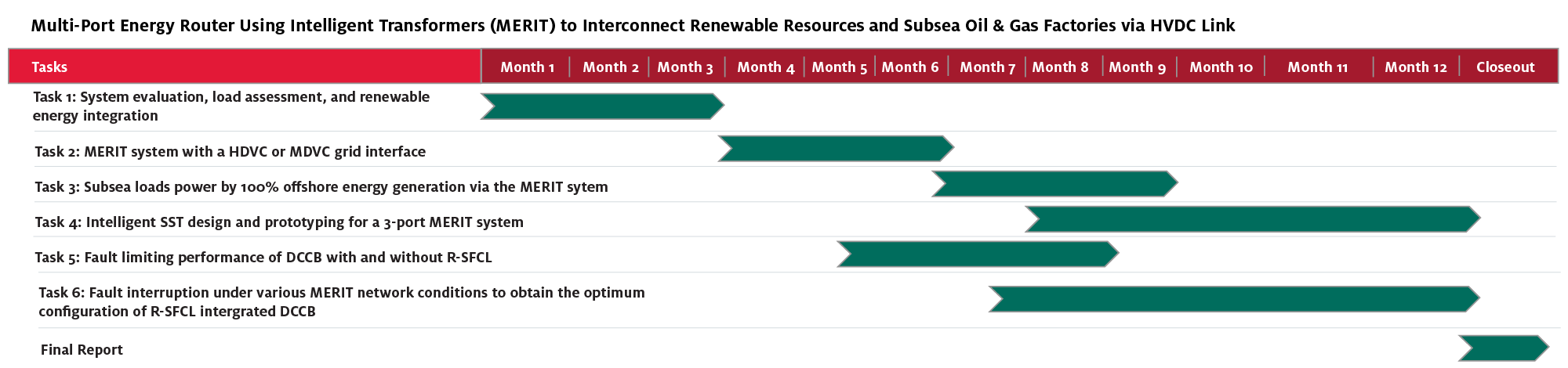
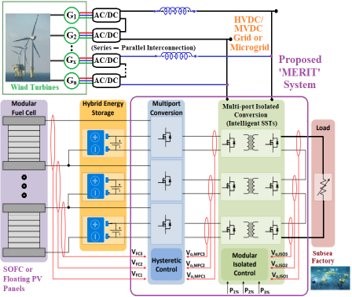
This project proposed a system of Multi-port Energy Routers using Intelligent Transformers (MERIT) to interface renewable resources and subsea O&G factories with the HVDC (or MVDC) grid. In this project, we investigated combining the energy from wind, wave, floating PV panels, and fuel cell-based generators, all located near the subsea factories, to power the loads. Intelligent power converters, including solid-state transformers (SSTs), were critical to enhance the power density, reliability, and efficiency of the proposed MERIT system. SSTs enabled seamless interconnectivity and interoperability between the various energy sources. They supported features such as instantaneous voltage compensation, power outage compensation, fault isolation, bi-directional power flow, etc. This research also investigated how to optimally design and integrate SSTs into the MERIT system to achieve the best performance during both transient and steady-state conditions. It was expected that widespread implementation of the proposed synergies could lead to over 50% reduction in emissions.
As one of the foremost requirements of a subsea power delivery system was reliability, HVDC protection units had to conform to extremely stringent specifications in terms of fault interruption time and fault level. However, a major challenge in the growth of the DC power market was the lack of reliable protection against short-circuit faults. A fault in a DC system resulted in a fast ramp-up of the fault current. Moreover, DC fault current did not experience any natural zero-crossing. Therefore, DC circuit breakers (DCCBs) needed to be capable of fast fault quenching to prevent damage to the DC system and maintain grid resiliency. Additionally, a DCCB had to operate with minimal power loss as a closed switch. Fault interruption using a DCCB caused enormous energy dissipation and voltage stress. If a DC fault current was 4–5 times higher than the rated DCCB, it could not work efficiently without expanding its components. Therefore, the use of a fault current limiter was essential, and the superconducting fault current limiter (SFCL) was the most promising choice together with a fast-switching DCCB in series. The resistive-type superconducting fault current limiter (R-SFCL) was one of the most ideal, compact, small-sized current-limiting devices to protect the power system and electrical equipment. It effectively limited the fault current in power systems where CBs could operate safely and prevented damage to the circuit components within several milliseconds.
Additional Media Assets:
Gantt Chart: