Today, a strange airplane wing. The University of Houston's College of Engineering presents this series about the machines that make our civilization run, and the people whose ingenuity created them.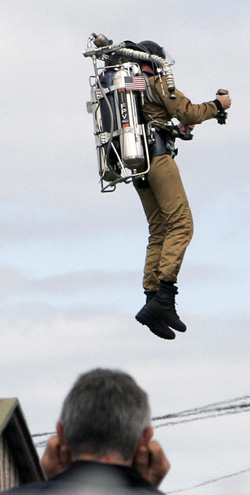
Certain ideas that seem workable often frustrate our attempts to put them to use. If they look to be sound, they'll often linger, even after repeated failure. Take perpetual motion machines; the abstract thermodynamic reasons why they're impossible weren't even formalized until a century and a half ago. They're still hard to understand. As a result, many intelligent people keep suggesting new variations of old failures.
But not all such ideas are impossible. Take the helicopter: Leonardo suggested it 500 years ago. Early airplane pioneers from the mid-19th century onward tried to build one. None succeeded and they finally turned to fixed wings.
Or think about the jetpack: We've long wanted to strap a Buck Rogers rocket on our backs and jet about town. It's clearly possible, but we keep butting up against issues of control and greedy fuel consumption.
And yet: Germany and America both had working helicopters by 1939. They're now part of our daily lives. You can also now buy a rocket belt that'll keep you aloft for nine minutes. But you have to be wealthy and ready to go through a lot of training.
The idea that started me on this thread is another one that's still pending. It's the annular wing. Imagine a biplane whose two wings touch and join at their tips so they form an annulus -- a squashed endless loop, a single wing with no tips.
What's to be gained, you might ask? The first people who tried it were airplane pioneers who were thinking of box kites. Box kites flew, so why not build airplanes like them. Several of the first successful airplanes looked exactly like box kites -- biplanes with vertical surfaces connecting the top and bottom wings. What you saw coming toward you was not an ellipse but a rectangle.
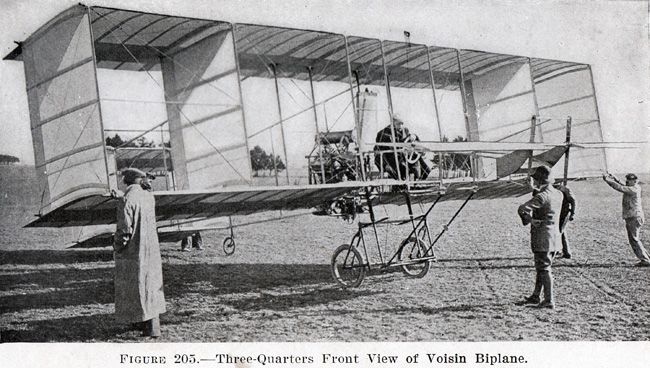
The box kite shape was clumsy-looking and soon abandoned. But one builder, Louis Blériot, began with a truly elliptical wing -- not a box structure. His first one failed and his second one bumped along the ground until it sort of halfway hopped into the air. When Blériot gave up on that design and went to monoplanes he was very successful. In 1909, he was first to fly the English Channel.
Today, the elliptical wing suggests another advantage for high speed flight -- eliminating wingtip vortices. Vortex-shedding at the tip creates drag and leaves a turbulent wake that can damage planes behind it. Those vertically bent wingtip devices you see in modern jets are there to reduce and redirect tip vortices.
While an elliptical wing will eliminate tip vortices altogether, its wake takes other forms. Model airplanes have flown with annular wings, but not until people build and test full-scale airplanes will we really know whether it can be made useful. So here is one more idea -- lingering and teasing us until we put the question to rest. But, as soon as we do, other ideas will remain -- quantum computing, teleportation -- always something.
I'm John Lienhard at the University of Houston, where we're interested in the way inventive minds work.
See the Wikipedia articles on closed wings and on Louis Blériot. See also a fine You-tube by a highly experienced teenage model builder.
Experimentation with closed-wing aircraft continues today. I have made no effort to seek out the ongoing ones here. But a more exhaustive web search is sure to yield examples.
Rocket belt image courtesy of Wikipedia commons, Blériot III is public domain, and Voisin airplane is from Vehicles of the Air (Reilly and Britton, 1909).
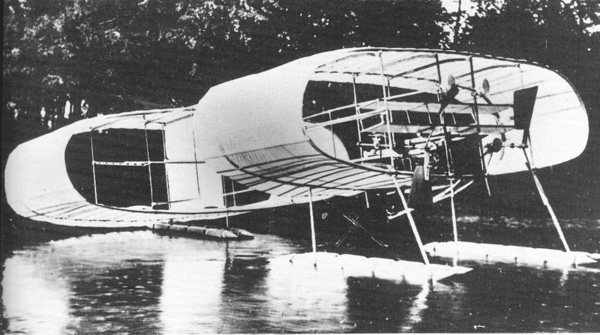
The Blériot III, closed-wing aeroplane, built by Louis Blériot and Gabriel Voisin in 1906. It did not succeed in getting off the water.